Completed
|
4
|
6
|
4302
Part 6
The day arrived quietly.
No dramatic air.
No sudden rush.
Just a slow, inevitable morning that felt heavier than usual — like the house itself knew what was going to happen.
Vansh woke early, well before his mother called him.
His braid had loosened overnight, but the weight of it still rested against his back — a reminder of the last few weeks of conditioning.
He stepped into the hallway, fully expecting the “station” to be ready.
It was.
Comb.
Oil.
Pins.
Fresh jasmine flowers.
His mother didn’t say much. She simply pointed to the chair.
He sat.
She undid his night braid, running her fingers through his hair. It had grown soft, smooth, obedient — not wild and careless the way it used to be.
“Maa,” he whispered, “today will be too much.”
She didn’t argue.
She just said, “Hmm,” very quietly, as if acknowledging his nerves without feeding them.
Then she began.
The Hair
The comb moved through his hair with slow, confident strokes.
She oiled her hands lightly — not too much, just enough to keep every strand aligned.
“Middle part,” she said.
He nodded.
She set the parting perfectly, pressing the hair down near the temples.
It was such a small detail, yet it transformed his face instantly — softer, neater, unmistakably traditional.
Then she began the braid.
This one was tighter than any she had made before.
Fold after fold.
Tug after tug.
Her fingers worked with the precision of someone who had braided hair for years.
He exhaled sharply as she tightened the base.
“Maa…”
“It has to be firm,” she said. “It should not move during the saree.”
He stayed silent.
She worked her way down, the braid forming like a rope — clean, even, and heavy.
Finally, she secured it with a rubber band and smoothed it once with her palm.
Then came the jasmine.
Not loose flowers — a proper gajra, wrapped carefully around the bun-like base and pinned neatly across the braid’s upper portion.
She stepped back and examined him once.
“Perfect.”
He swallowed.
He felt too aware of every part of himself — his hair, his breath, the tightening at his scalp, the heaviness behind him.
But there was no turning back.
The Blouse
She handed it to him — the deep red-green combination, elegant and unmistakably feminine.
“Go wear it,” she said.
He changed silently and stepped out.
It fit exactly the way she had planned.
Firm around the shoulders.
Structured around the chest.
The sleeves hugged him neatly, no wrinkles, no looseness.
She adjusted the neckline with a practiced tug.
“Stand straight.”
He corrected his posture automatically.
His mother gave an approving nod.
The Saree
She unfolded the rich red silk saree with gold border, the same one he had tried earlier — except today, her handling of it felt ceremonial.
“This is not a trial,” she said.
“This is the real thing.”
He nodded, breath shallow.
She tied the petticoat around him — tighter than last time, tight enough to anchor everything.
“Maa—”
“Shh.”
She tucked the saree into the petticoat and began pleating.
Her fingers moved quickly, creating identical folds, each one sharp and controlled.
The pleats aligned perfectly, falling straight to the floor.
“You are not to touch them,” she warned.
“I won’t,” he whispered.
She adjusted his stance with her hands — a slight push on his shoulder, a tap under his elbow, a correction of his feet — large, subtle instructions meant to shape his entire posture.
Then she lifted the pallu.
It fell beautifully — red silk, gold border glowing under the morning light.
She set it across his shoulder, pinned it discreetly, and smoothed it down his arm with one long motion.
“There,” she murmured. “Now it looks right.”
He didn’t trust himself to speak.
The Jewelry
She began with the jhumkis.
Not clip-ons today — real ones.
The kind that were slightly heavier, slightly more noticeable.
“Maa, are you sure—”
“Be still.”
She attached them carefully.
His breath hitched at the weight.
Next came the necklace — a soft gold chain with a traditional pendant.
It settled against his collarbone, cool at first, then warm.
Then the bangles.
Many of them.
She slid them onto his wrists slowly, one by one.
He tried not to flinch.
The light clinking sound felt strangely intimate.
The Mirror
When she was done, she turned him toward the long mirror.
He stood there, frozen.
The person in the reflection…
…was him.
But also not him.
Red silk.
Green blouse.
Perfect braid with jasmine.
Sharp pleats.
Gold jewelry catching the light.
A stillness in his posture that he had never known.
A neat, traditional grace he didn’t know he could possess.
“Maa,” he whispered, barely audible, “this… this doesn’t look like me.”
His mother placed her hand gently on his shoulder.
“It looks exactly like you, Vansh,” she said softly.
“Just the version you never thought to see.”
He didn’t trust himself to answer.
She adjusted one last pleat, stepped back, and nodded.
“All right,” she said. “Let’s leave. Everyone is waiting.”
He turned to her, voice trembling slightly:
“Maa… what will they say?”
She smiled — not teasingly, not mockingly, just with a calm certainty only mothers possess.
“They will say you look beautiful,” she answered.
“Because today… you do.”
He swallowed, nodded once, and followed her out of the house — every step constrained by silk, every movement guided by the braid, every breath tight inside the blouse.
The function awaited.
And he had never felt more exposed —
or more carefully put together —
in his entire life.
Part 7
Vansh walked out of Vinita’s room slowly, the saree weighing on him like a real presence, not just fabric.
He had barely taken five steps into the living space when the first voice came:
“Oh ho ho… look who is ready.”
It was Masi — the one who always spoke first, always commented first, always found a joke before anyone else.
She put her hand dramatically to her chest.
“Arey Vansh beta—”
She paused, eyes widening, smile stretching.
“No… today not beta. Aaj toh pura ladki lag raha hai.”
He felt heat rush to his face.
Before he could respond, Bua walked in behind her and actually stopped mid-stride.
“Wait— wait— wait.”
She moved closer, squinting at him with that mischievous investigator expression she always had.
“This is… Vansh?”
Masi snorted.
“Who else? Ghost? Model? Or some shy daughter-in-law who got lost and entered our house?”
The women burst into laughter.
Vansh inhaled tightly through his nose.
Maa… why didn’t you warn me they were already here…
Bua gently lifted his pallu.
“Silk. Perfect pleats. And this hair…” She inspected the sleek, pinned style. “Vinita, tu toh kamaal kar deti hai.”
Vinita appeared from the kitchen doorway, smiling like she had expected every reaction.
“I didn’t do anything,” she said calmly. “He wanted to look neat.”
He shot her a betrayed glance.
She ignored it with pure maternal talent.
Masi clapped her hands suddenly.
“Stand straight! Let us look properly.”
Vansh froze on the spot.
They walked around him.
Literally — a full circle inspection.
Like he was a sculpture presented for approval.
Bua tapped her chin thoughtfully.
“He actually looks… pretty.”
Masi nodded.
“Hmm. I didn’t expect this much. Vansh, dear, turn around.”
He turned stiffly.
The women burst into another round of delighted teasing.
“Ayyy, see the waist!”
“Look at the pallu fall!”
“Vinita, he looks more graceful than half the girls who will come today!”
“He is glowing — look at his face!”
Vansh wanted to disappear.
But there was no escape.
Photos. Endless, unstoppable photos.
“Phone lao! Quick quick quick!”
Before he could blink, Masi had her phone out.
“Stand next to the wall— yes, that one. No, straighten the pleats first— yes— very good.”
“Masi— please—”
“Shh. Smile.”
He tried to give a normal smile.
“No! Not like that! Smile properly!”
He attempted again.
Bua stepped closer and adjusted his pallu.
“There. Now perfect.”
Click.
Click.
Click-click-click.
He blinked.
“Are you… are you done?”
“No.”
Both of them said together.
Another photo.
Another one.
A third.
A close-up of the jhumkas.
A full-length shot.
A vertical, a horizontal, a candid, a forced candid.
Masi sighed happily.
“I swear, Vansh will steal the whole function today.”
Vansh stared at his feet.
“Please don’t say that…”
“Oh? Why not?” Bua teased.
“You look lovely. Look at your cheeks— so shy.”
He exhaled shakily.
The Struggle
As he tried to move, the saree pulled tightly around his waist.
The pleats tugged every time he shifted.
The blouse pressed firmly against his chest and shoulders, making each breath feel unusually deliberate.
The jewelry didn’t help — the jhumkas tugged his ears with every little tilt of his head.
But he kept quiet.
Because he wouldn’t admit discomfort.
Not even to himself.
He walked slowly to the living room sofa, and the moment he sat, the saree pulled again, the pleats resisting.
Both women immediately leaned forward.
“Careful!”
“Sit properly!”
“Don’t ruin the pleats!”
He froze mid-movement.
Vinita came over and gently adjusted his saree again, tugging the fabric, smoothing each fold, making sure everything sat perfectly.
“There,” she said softly. “Now don’t move too much.”
Vansh nodded, cheeks warm.
The Ritual Begins
Half an hour later, more women arrived — cousins, aunties, neighbours — and each one reacted the same way:
First shock.
Then delight.
Then teasing.
Then photos.
Vansh stopped reacting after the eighth comment.
He simply stood there quietly, hands together, pallu draped neatly, trying not to trip on the edge of the saree.
When the ritual finally began, Masi tapped his arm.
“Come, you sit here.”
“Why me?”
“Because today you will perform the girl’s side ritual.”
He stared at her.
“Masi… I’m not—”
“You look like one today. It fits.”
There was no argument after that.
He knelt slowly, every movement controlled so the saree stayed in place.
He placed the flowers, the diya, the offerings just like Vinita told him.
The women around him sighed dramatically.
“Awww, so graceful.”
“Dekho dekho, even the way he bends is pretty.”
“Vinita, next time also bring him like this.”
Vansh felt his ear tips burn.
But he didn’t complain.
He followed every instruction.
He lit the diya.
He folded his hands.
He bowed his head when told.
And somehow… nobody laughed.
They teased, yes.
They joked, yes.
But during the ritual — they simply watched.
Not mockingly.
Almost approvingly.
When the diya flame steadied, Vinita whispered:
“Good. You did it beautifully.”
He didn’t look up.
He just breathed — carefully, quietly.
More Photos. More Praise. More of Everything.
The moment the ritual ended, chaos returned.
“Wait, Vansh, one photo with me!”
“One with all the cousins!”
“Turn this way — light is better!”
“Vansh, you look too good yaar. How?”
Someone even said:
“He should come dressed like this every year.”
Vansh’s heart stumbled.
“No. No way.”
They laughed.
But the compliments kept coming.
“Your hair looks perfect.”
“This color suits you.”
“Your posture is so elegant.”
“Your eyes look bigger in this hairstyle!”
“You don’t even look uncomfortable!”
He smiled politely.
If only they knew.
His waist was stiff.
His ears were sore.
The blouse felt like a quiet trap.
And the saree refused to let him walk freely.
But he said nothing.
He just stood there — looking exactly like they wanted him to look.
The Moment of Realization
As Vinita adjusted the pallu one last time before leaving for the venue, she said quietly:
“See, Vansh? You handled all of this.”
He swallowed.
“But Maa… I didn’t expect all this.”
“I know.”
She touched his cheek briefly.
“But you managed. With dignity.”
He exhaled slowly.
The house buzzed around him.
Women laughed, joked, talked loudly.
Phones clicked.
Bangles clinked.
Sarees rustled.
And he stood in the middle of it all — a boy dressed like a girl, being treated like one, praised like one, teased like one…
Yet not humiliated.
Not mocked.
Just…
Seen.
Vinita placed the final clip in his hair.
“We leave in ten minutes,” she said softly.
Vansh nodded.
He wasn’t ready.
But he didn’t resist.
Because today… there was no going back.
Part 8
The house was strangely quiet when they returned, as if the noise and brightness of the function had stayed behind and only the soft remains of the evening clung to the air here.
Vansh stepped inside carefully, holding the pallu with one hand so it wouldn’t slip. His back felt tense from sitting straight for hours, his waist was stiff, and the earrings had tugged on his ears the entire time. When he finally removed his sandals, the coolness of the floor almost shocked him.
Vinita closed the door and gave him a small, knowing look.
“Sit,” she said, gentler than she had been all evening.
He sat on the edge of the bed, adjusting the saree automatically — he didn’t even realize he was doing it until she smiled faintly.
“You got used to it,” she murmured.
He didn’t reply.
She stepped behind him and touched his hair. The bun was still intact, though a little loose after the long day. Her fingers opened the pins slowly, carefully. Each pin came out with a soft click. His hair unfurled gradually, falling heavy, warm, and slightly scented from the jasmine they had tucked in earlier.
The weight of it surprised him.
He had forgotten how long it really was under all that neatness.
Vinita gently combed through the strands with her fingers, loosening them, letting them fall over his back like a dark curtain.
“You managed beautifully,” she said quietly. “Better than I expected.”
Vansh let out a half-laugh, tired and raw.
“Maa, I thought I would trip in front of everyone.”
“You didn’t.”
“The blouse was tight.”
“I know.”
“The jhumkas pulled so much…”
“I saw.”
“And they kept taking pictures,” he muttered, leaning forward slightly as she loosened another section of hair. “So many pictures. I didn’t even know where to look.”
Vinita smiled.
“They were proud. And curious. And a little shocked.”
He groaned softly.
“Masi is going to tease me for years.”
“Probably,” she admitted without apology.
The saree loosened as she unpinned it from his shoulder. Slowly, carefully, she peeled the fabric away from him, fold by fold. The pleats came undone and pooled onto the bed like a quiet waterfall.
He exhaled, shoulders dropping in relief.
Vinita folded the saree neatly beside her and tapped his shoulder.
“Now go change into your night clothes.”
He nodded, stood, and returned a few minutes later, hair still loose around his shoulders, falling as freely as it had in months. He sat down on the bed again, calmer now.
For a moment, neither of them spoke.
Then she said, “The function went well.”
He nodded.
“And you handled everything politely,” she added.
Another nod.
“You didn’t complain.”
“I didn’t want to create drama,” he muttered quietly.
She smiled at that.
“You did well, Vansh.”
He looked down at his hands.
“Everyone kept looking at me,” he said softly. “Not in a bad way. But… it felt strange.”
“Of course it did,” she replied. “It was new. But you held your dignity.”
He gave a tiny, tired smile.
“Maa, next time please remind me to walk slower in saree.”
She laughed lightly.
“You walked fine. Only the pleats tugged a little when you sat.”
He pressed his palm to his forehead.
“I knew it.”
“Everyone knows it,” she said. “Even girls struggle on their first proper saree ceremony.”
He sighed, half amused, half defeated.
Then Vinita shifted slightly, leaning back against the pillows.
“Vansh,” she said, tone deceptively casual, “now that the function is done… we must talk about something.”
He narrowed his eyes immediately.
“That tone is dangerous.”
She ignored him.
“You have kept your hair long for a year and a half,” she began. “And now it is truly long. Long enough to comb properly, to braid properly, to style properly.”
“Maa—”
“I won’t let you keep it messy anymore.”
“Maa— wait—”
“Which means,” she continued, “until you decide to cut your hair, you will dress properly at home.”
He blinked.
“What?”
She lifted a brow.
“You heard me.”
He stared, half laughing, half horrified.
“You mean— daily? Maa, come on— you’re joking— right? That was a one-day thing!”
She crossed her arms.
“Was it? You handled yourself well today. Very well. And longer hair comes with responsibility. So until you cut it, we will keep it neat, tied, oiled, combed. And…” — she gave a small, unmistakably playful smile — “we will dress accordingly.”
“Maa!”
He widened his eyes. “I’m not going to wear sarees every day!”
“No, not sarees,” she corrected calmly.
“Salwar. Dupattas. Simple suits at home. Comfortable. Neat. And appropriate for managing long hair.”
He stared at her with exaggerated disbelief.
“You’re serious?”
She smiled serenely.
“If you don’t want that,” she said, “then tomorrow morning we will go to the barber and cut your hair.”
That landed like a bell in the room.
He froze.
“No…”
A beat.
“No, no, no. Not after growing it for so long.”
She shrugged.
“Then follow the routine.”
He pointed a finger at her dramatically.
“This is blackmail.”
She shrugged again.
“This is discipline.”
He groaned, falling back on the bed.
“Maa, please—”
She laughed softly.
“Goodnight, Vansh. We will see what you choose in the morning.”
Part 9
The Next Morning
When he woke, his hair was everywhere — tangled, scattered, brushing over his face, his eyes, his neck. He pushed it back only for it to fall again.
He stared at himself in the mirror.
This much hair…
Cutting it now felt unthinkable.
It had become part of him.
He walked out reluctantly.
Vinita was already waiting.
On the bed lay:
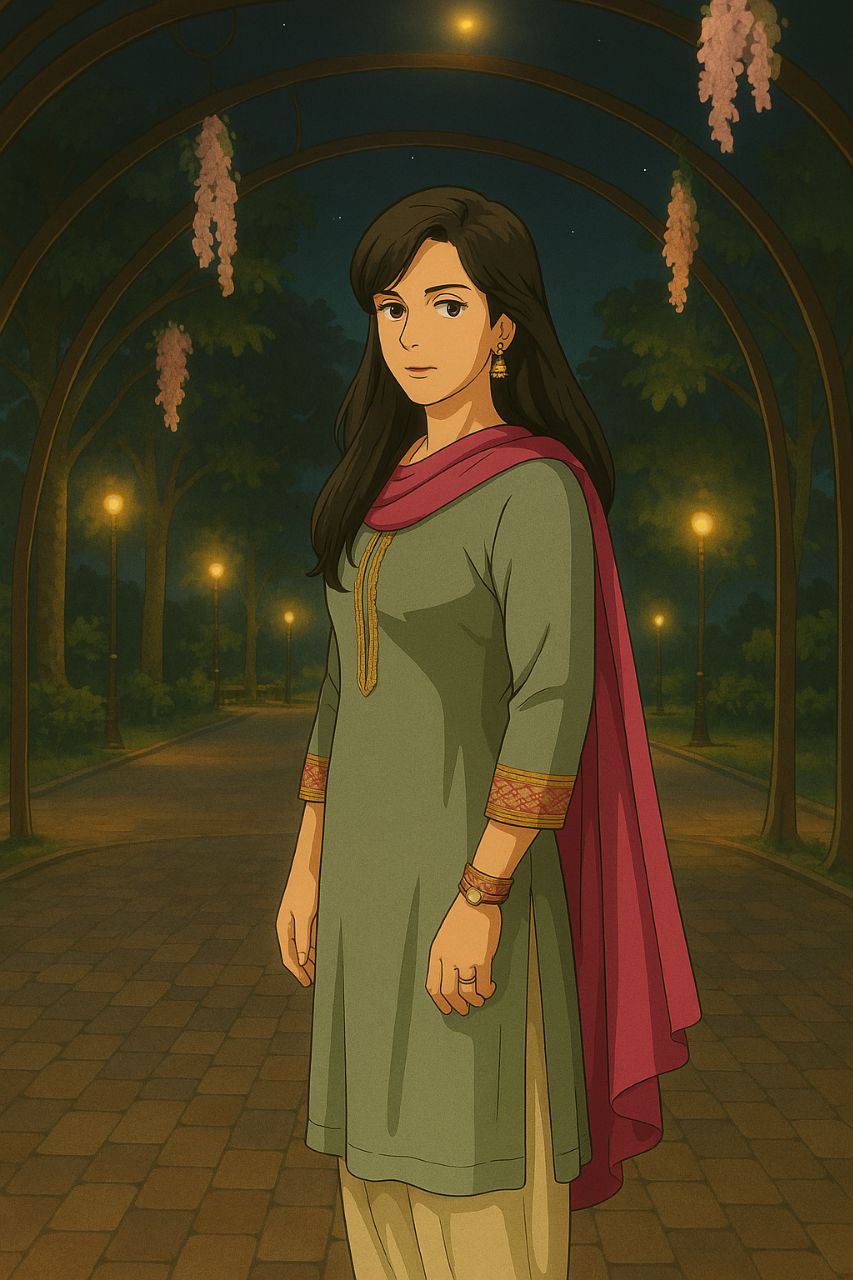
A soft cotton salwar kameez, pale and simple
A matching dupatta
A set of light bangles
A delicate pair of small jhumkis
A neatly placed comb, oil, and ribbon for his hair
She didn’t say anything.
She didn’t need to.
Vansh looked at the clothes.
Then at his hair.
Then at her.
He sighed.
“Fine, Maa.”
Her smile was small but triumphant.
He sat down quietly.
Vinita combed his hair with slow, even strokes, smoothing every knot, every strand.
Then she braided it — a long, tight, neat braid that felt almost symbolic in its weight.
She helped him into the salwar, guiding the dupatta over his shoulder, adjusting the folds so it fell gracefully.
The small jhumkis clicked softly when he turned.
The bangles tapped lightly each time he lifted his hand.
He looked at himself.
Not like yesterday’s grandeur.
Just simple.
Neat.
Soft.
Domestic.
A quiet, almost serene version of himself.
Vinita stood behind him.
“Now,” she said, touching his shoulder gently, “you study. And when I call you, you help me in the kitchen.”
He swallowed, then nodded.
He didn’t know whether this was the beginning of a phase…
or something deeper, something he couldn’t yet name.
But he didn’t cut his hair.
He accepted the braid.
He accepted the salwar.
He accepted the new rhythm of his days.
And the house accepted him too.
A boy in long hair.
A boy in neat clothes.
A boy moving through rooms with the quiet grace his mother kept shaping into him.
Not a performance.
Not a punishment.
Just a slow, steady shift in the rhythm of life.
Something he never expected…
But something he no longer denied.
Part 10
It had been five years since Vansh quietly accepted his mother’s request.
Five years since he chose not to cut his hair.
Five years since the saree from that single function became the beginning of a lifestyle he never expected.
Outside the house, in college, with friends, in public spaces—Vansh remained exactly who he always was: a regular boy, jeans and shirts, confident, normal, unnoticed in the best way.
But inside the house…
his world had reshaped itself slowly, tenderly, without force, without drama—just a rhythm that settled deeper each month, until it became second nature.
And he did not resist it anymore.
He woke early these days, not because anyone forced him, but because the routine had settled into him like breath.
He pushed the blanket aside, sat up, and his hair fell forward in a long, soft wave—thick, dark, and reaching all the way to his hips now. It always brushed his elbows when he stretched, and he no longer flinched at the sensation.
It was simply a part of him.
He went to his wardrobe, opened the inner section where his home-clothes were neatly arranged, and chose the outfit for that day.
It was a “saree day.”
Four days of the week were like this now—light, comfortable cotton sarees at home.
The remaining three were kurti days—simple, soft, flattering.
Everything alternated with a rhythm his mother had taught, and he maintained it without reminders.
He slipped into the blouse first—tight, fitted, familiar. The coolness of the fabric against his skin was something he had grown used to. He tied it properly, adjusted the back hooks, checked the fit, and then draped the saree around himself with an ease that would have shocked his younger self.
The folds fell into place precisely.
The pleats aligned with almost instinctive accuracy.
His fingers no longer trembled; they moved with the quiet confidence of someone who had practiced hundreds of times.
When he pinned the pallu to his shoulder, it rested gracefully, like it belonged there.
He added his daily home set of glass bangles—thin, soft-toned—and the tiny bindi he had come to place almost without thinking. A pair of modest jhumkas completed the set.
Then came the hair.
Some days he left it loose.
Some days he tied a soft puff.
Some days he shaped a ponytail that swung when he walked.
Some days he braided it neatly, long and heavy, swaying down to his waist.
Some days he pinned it into a clean bun.
And some mornings—when he was lazy or in a hurry—he twisted it into a messy bun with a few strands falling around his face.
Today he chose a braid.
He oiled the ends lightly—his mother’s rule—and combed through the length slowly, parting it cleanly. His fingers worked downwards, looping the sections together until the braid settled neatly across his back, heavy and perfectly straight.
When he finished, he looked at himself in the mirror.
He didn’t see awkwardness anymore.
He didn’t see discomfort or hesitation.
He saw a version of himself that belonged to the quiet spaces of the house—a domestic, calm, composed version that existed only here, in these rooms, with his mother.
And he didn’t resent it.
Not anymore.
He stepped into the dining room where Vinita had already begun her morning tea.
She smiled as soon as she saw him.
“Heavy braid today?” she asked softly.
“It felt easier,” he replied, adjusting the pleats.
She nodded without commentary.
He swept the living room first, moving with the measured, graceful steps his Kathak teacher always insisted on.
His pallu didn’t slip anymore. He knew how to hold it with one hand, how to bend without loosening the pleats, how to move in rhythm.
Then came mopping.
Then dusting.
Then folding the laundry.
Then peeling vegetables.
They were wealthy enough to hire help—several times over, in fact—but Vinita never stopped him from doing the chores, not after she saw how sincerely he handled the household.
She said he made the home feel lived in.
And Vansh, for reasons he never fully explained, accepted the rhythm without argument.
Every morning for an hour, and every evening for another, he went to his Kathak classes—the private ones Vinita arranged so no one else would judge him, question him, or misunderstand him.
His teacher never spoke about his clothes.
Never asked why he prefered individual instruction.
Never hinted discomfort.
Vinita paid enough to ensure silence, privacy, and respect.
And over five years, Vansh became extraordinary.
The spins came effortlessly.
The postures held firmness.
The expressions softened, matured, deepened.
He learned to walk with grace, to move with precision, to turn in silence and land like a feather.
His teacher once said quietly, “You dance like someone who has lived many lives.”
Vansh only smiled.
He performed at cultural plays often now.
Usually when a girl became unavailable at the last moment…
or when a role required elegance and discipline…
or when the troupe needed someone reliable.
He never advertised it.
He never told his college friends.
But on those small stages, in those temporary lights, he found a strange, grounded calm.
A sense that he could inhabit a space without pretending.
The ghungroos wrapped around his ankles felt like the most natural sound in his life.
After his evening class, he returned home, changed into a fresh kurti or saree—depending on the day—and tied his hair again.
Sometimes a bun.
Sometimes a ponytail.
Sometimes a braid.
Sometimes loose waves that touched his hips.
He prepared dinner with Vinita, moving around the kitchen with a grace born of habit.
He washed utensils at night—something he had added to his routine without being asked.
The water, the soft clink of steel, the quiet swish of his bangles—it all blended into a quiet rhythm he didn’t think about anymore.
By the time he went to sleep, his body felt used, grounded, and calm.
He combed out his hair one last time, braided it loosely, and lay down.
Vansh wasn’t pretending anymore.
Not resisting.
Not confused.
Just… settled.
At home, he moved like someone who belonged to softness, to discipline, to rhythm.
He carried himself with an ease he didn’t have as a teenager.
He dressed with quiet confidence—blouse, saree, bangles, jhumkas—like someone who understood how clothes could shape the energy of a space.
He walked differently now.
Danced differently.
Spoke differently.
Handled things differently.
His mother watched this change with a soft pride.
Not delight.
Not victory.
Not control.
Just pride.
Because her son—her Vansh—had grown into a calm, mature, balanced version of himself.
Outside he remained the young man everyone knew.
Jeans. Shirts. Regular hair tied back simply.
But at home…
He was something else entirely.
Something softer.
Something quieter.
Something beautifully disciplined.
A young man who lived between two rhythms and balanced both without losing himself.
And neither he nor Vinita wished to change that anymore.