
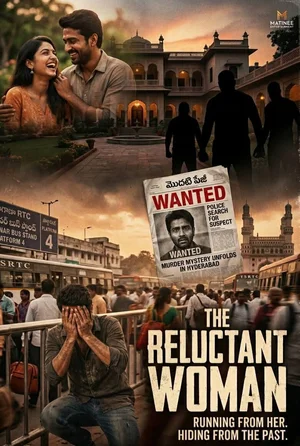

Chapter 28
The Morning After
The first thing Vijay noticed was the light.
It came through the tall bedroom window in long, unhurried bars — the particular gold of a Godavari morning that has not yet decided to become hot, a light that lands on everything gently and asks nothing. The ceiling fan moved the warm air in slow circles above him. Somewhere downstairs, something was happening in the kitchen. The clatter of a vessel. Water running. The distant, domestic smell of a house waking itself up.
He lay still for a moment and let himself notice all of it.
The night before — the three of them in the study, the confessions laid out one by one like cards placed face-up on a table, the long careful planning that had followed — had ended near two in the morning. He had come upstairs to find Ramana already in the room, sitting on his side of the bed in the dark, apparently doing nothing except waiting for the day to end. They had not spoken. There had been nothing left to say that had not already been said, and the silence between them had been, for the first time, the comfortable silence of people who know where they stand with each other rather than the careful silence of people concealing where they stand.
Ramana had been asleep within minutes. Vijay had lain awake considerably longer.
He turned his head now and looked at his brother's sleeping face — the strong jaw, the slight furrow between the brows that Ramana carried even in sleep, as though some part of him could not entirely let go of vigilance. At twelve years old, standing at a gate watching a twenty-four-year-old man walk away, Vijay had memorised that face in the particular desperate way of someone who understands they may not see it again for a long time. He had not expected the long time to be fifteen years. He had not expected, either, to see it again from this particular angle, in this particular room, wearing a thali that Ramana's own hands had placed around his neck.
He got up quietly, the yellow cotton nightdress settling around his legs, and went to begin the day.
---
An hour later, Priyanka stood before the bedroom mirror in the full light of morning.
She had chosen a cotton saree in a warm terracotta — the deep, earthy orange-red of fired clay, soft and breathable, a colour that belonged to morning kitchens and back courtyards and the unhurried rhythms of a house that is lived in rather than performed in. The fabric was good quality but entirely unpretentious, the kind a woman reaches for on an ordinary day without thinking twice about it. The border was a narrow band of dark maroon, simple, without ornament.
The blouse was short-sleeved, fitted close to the body, its neckline a modest square that nonetheless sat low enough to reveal the gentle upper curve of her heavy breasts — full and warm above the terracotta cotton, the skin smooth and faintly sheened with the heat of the morning kitchen where she had already spent an hour. The thali, thin gold, rested against her collarbone and disappeared into the soft valley of her cleavage — a new weight she was still learning the feel of, settling now against her skin with a permanence that was no longer entirely foreign. The blouse's fabric clung at the chest and softened slightly over the midriff, framing everything with the natural, unstudied quality of a woman who has dressed this way every day of her adult life.
The saree was tied in the style she had made her own over weeks of practice — low on the wide hips, the waistband sitting just below the navel, leaving a generous expanse of bare midriff entirely exposed. The smooth, warm skin of her stomach caught the morning light softly, the deep navel a quiet shadow at the centre of it. There was nothing theatrical about the exposure here. It was simply the way the saree sat, the way thousands of women in thousands of kitchens across the delta tied their sarees every morning — practical, unselfconscious, alive. The full roundness of her hips was visible in the terracotta fabric as it draped across them, the cloth falling in clean, natural folds to her bare feet. Her figure — the weight and fullness of the breasts above, the narrow dip of the waist, the generous flare of the hips below — moved through the morning with the settled ease of someone who has stopped fighting what they are carrying and started simply carrying it.
Her hair was damp from the morning bath, combed through and twisted into a simple, low bun at the nape of her neck, fastened with two pins and nothing else. It was not the elaborate jasmine braid of the stage or the careful bridal arrangement of the wedding morning. It was the bun of a woman who has been up since five-thirty, has already managed a kitchen and two school tiffin boxes, and has pinned her hair out of her face because she has better things to think about. A few strands had escaped at the temples and at the nape, curling slightly in the humidity — not styled, simply present.
A single jasmine flower was tucked into the bun near the left side. Not a garland, not a decoration. One flower, slightly wilted from the morning, that Kavya had pressed into her hand at the kitchen door twenty minutes ago without explanation, the way children offer gifts — abruptly and with complete sincerity. Priyanka had put it in her hair without comment and gone back to the dosas.
Her face in the morning mirror was the version of Priyanka that the stage and the checkpoints and the goon-filled performance nights had never quite produced — not polished, not strategic, not arranged for effect. The kajal was applied but lightly, a thin line rather than the dramatic sweep of performance evenings, making her eyes appear large and dark and simply awake rather than deliberately seductive. The red bindi on her forehead was the everyday size — small, precise, a habit now, the action of pressing it into place each morning having become part of the rhythm of waking the same way reaching for a toothbrush was. Her full lips were bare of gloss — their natural colour, the deep rose of morning, slightly dry at the corners from the hot kitchen air.
At her wrists, a single set of thin glass bangles — four red, two gold — that chimed softly every time she moved her hands, which was constantly. Not the stacked, deliberate display of performance nights. Simply bangles, worn the way a married woman wears them, present and unremarkable and making their small sound in the ordinary air of an ordinary morning.
The small gold nose stud caught the light when she turned her head. The thin gold jhumkas in her ears — smaller than the statement pieces she wore for shows — swayed when she moved. Her feet were bare, the simple toe ring on the right foot the only adornment below the ankle, the terracotta saree falling in soft folds around them.
She looked, in the morning mirror, exactly like what she appeared to be — a young housewife in the middle of an ordinary morning in a house she has been running long enough to know its rhythms. The warmth of the kitchen was in her skin, a faint flush at the cheeks and collarbone. The thali at her throat was real. The bun was practical. The escaped strands were unstudied.
Vijay looked at this face — Priyanka's face, his face — for a moment before turning away.
Then he went downstairs to call the children for breakfast.
---
The dining table at seven in the morning had a different quality to the dining table at dinner.
Dinner was the considered version — everyone slightly more aware of each other, the day's events available for discussion, the mood of the household legible in how people sat and what they chose to say. Breakfast was rawer. Arjun arrived with his hair not entirely cooperating and his mind already at school before his body had finished its rice. Kavya arrived in stages — first her voice from upstairs announcing she couldn't find her left shoe, then the shoe, then Kavya herself, still tucking in her uniform shirt, collapsing into her chair with the dramatic exhaustion of someone who has been awake for fifteen minutes.
Ramana arrived last, dressed and composed, and stopped in the kitchen doorway for one unguarded moment when he saw Priyanka at the stove in the terracotta saree — the bare midriff warm in the morning light, the jasmine flower in the low bun, the bangles chiming as she moved a vessel off the flame. Something crossed his face that he arranged before he came to the table, but not quite before Vijay noticed it.
Vijay filed it. Said nothing. Put the dosas on the table.
"Kavya," Priyanka said, setting a plate in front of her, "your left shoe was under your bed. Arjun moved it when he vacuumed his room on Saturday and forgot to put it back."
Kavya looked at her brother with an expression of profound betrayal.
"I was going to tell you," Arjun said.
"When?"
"Today. Sometime today."
"It is today."
"It's still morning. I had time."
Ramana, reaching for his coffee, said without looking up: "Both of you. Eat."
His voice had its usual morning authority. But the corner of his mouth had moved. Vijay saw it. Kavya saw it too — she looked at her father's almost-smile with the alert delight of a child who has been cataloguing such moments and treating each one as a minor miracle.
---
The children left at eight. The house exhaled.
Ramana lingered at the table with his second coffee — something he had not done before the past few weeks, when the dining table had become, without announcement, the place where the household's mornings actually happened. He turned his cup in his hands and looked at the window. Priyanka sat across from him, her own tea cooling, sorting through the week's grocery requirements in her head with the efficient attention she brought to the logistics of the house.
The study was where they had spent the deep hours of last night. What had been said there was not reversible. What had been planned there was already in motion. But here, in the ordinary morning light, with the dosa plates still on the table and Kavya's school bag strap trailing off the back of her chair where she had forgotten it for the third time this week, none of that felt like the primary fact.
The primary fact was this: two people sitting across a table, in a house that smelled of jasmine and cooking oil and morning coffee, with the particular ease of people who have stopped performing and started simply being present.
"She's going to forget that bag every day for the rest of her life," Ramana said. To the window. To no one in particular.
"I know," Priyanka said. "I've started putting a spare set of stationery in her desk at school."
He looked at her.
"When did you do that?"
"Two weeks ago. After the third incident."
He looked at her a moment longer. Then he looked back at the window with the expression Vijay had come to recognise — the one that meant he was revising something internally and had decided to do it privately.
"Thank you," he said.
It was the first time he had said it without the careful courtesy of a man performing gratitude. It came out simply. Like a person saying a true thing to another person, the way true things are said when the distance between people has closed enough to make simplicity possible.
Priyanka looked at her tea. "It's nothing," she said. "Eat the last dosa before it goes cold."
He ate it.
---
By the third day, something in Ramana had visibly shifted.
Not dramatically. Not in a way that would have been legible to someone who hadn't been watching him carefully for weeks. But to Vijay, who had been paying very close attention — and to the children, who paid close attention to their father with the focused instinct of young people whose emotional weather depended partly on his — it was unmistakable.
He laughed at breakfast.
A real laugh, not the brief, managed version he produced occasionally when something amused him and courtesy required acknowledgment. A proper laugh — startled out of him by something Priyanka said about Babai's expression at the dinner table the night of his arrival, a quiet observation delivered so precisely and with such perfect comic timing that Ramana had no defence against it. The laugh came out before he could decide whether to allow it, and once it was out he had the expression of a man who has sneezed in church — briefly embarrassed, and then, when he looked at Priyanka's small satisfied smile, not embarrassed at all.
Kavya stared at her father as though he had performed a magic trick.
Arjun said nothing, but he ate the rest of his breakfast with the particular quality of unhurried contentment that was, for Arjun, the equivalent of a wide smile.
---
What had been agreed in the study was this: the household would continue exactly as it had been. Priyanka remained Priyanka — wife, mother of the house, woman in the terracotta saree with the jasmine in her bun. Ramana remained the man who had married her. The performance of a contented household would serve two purposes simultaneously — it would maintain Suresh's confidence that his design was proceeding as planned, and it would keep the children from any awareness that the ground under their lives had been shifting.
What neither of them had discussed was the degree to which it was no longer entirely a performance.
The laughter at the breakfast table had been real. The ease of sitting across from each other with cold tea and the children's noise and the ordinary debris of a morning — that was real. The way Ramana had started arriving at the dining table slightly earlier than necessary, which was the only form of eagerness his nature permitted — that was real.
Vijay noticed all of it from behind Priyanka's eyes and filed it without comment, because commenting on it would have required naming it, and naming it would have required deciding what it was, and deciding what it was would have introduced a complication that the mission did not currently have room for.
He told himself this every morning while putting jasmine in his bun and going down to start the coffee.
He was not entirely sure he believed it.
---
He came on a Thursday afternoon, four days after the study meeting.
The children were home from school, Kavya doing homework at the dining table with a level of visible suffering disproportionate to the actual difficulty of the assignment, Arjun reading in his room. Priyanka was in the kitchen in a fresh pale green saree — the terracotta had been changed after the morning's cooking — standing at the counter cutting vegetables with the efficient, unhurried rhythm of someone who has done this particular task enough times that her hands know what to do without instruction. The kitchen smelled of ginger and curry leaf and the particular sweetness of onions starting to caramelise.
She heard the someone open the main gate. Then Ramana's voice at the front door — the slightly more formal register he used with visitors, not cold, but with the additional layer of composure he put on like a coat when the house received strangers.
Then footsteps in the corridor, and Ramana appeared in the kitchen doorway with a tall, familiar figure behind him.
Suresh still dressed as Sandhya. A sensual looking woman in saree.
To be continued. ...
Discussion (6)
Please continue the story and add thriller and romance stories too.
कृपया कहानी को आगे और लिखिए। थोड़ा रोमांस भी इसमें होना चाहिए
Wow..what a story..really mindblowing ..you nailed it Lavs.
I want this story to have some romance, kissing and sex.
I just started reading it... will give a detailed feedback once done. So far my opinion is awesome.
You might find few parts of this story taboo'ish... I suggest keep reading 🙂