Chapter 13: Dawn in a Red Saree
The months after the raids brought a quiet rhythm I had never known as Vijay. The constant fear that once kept me awake slowly loosened its grip, replaced by something gentler—simple routines, quiet purpose, and the small joys of ordinary days.
One peaceful evening in the temple quarters, Parvati rested her hand on mine. “It’s time,” she said softly. “No more hiding. Let the village see us as we truly are.”
The news spread through Shankarpally like wildfire. Two women living together. The quiet researcher who had helped so many, and the priest’s daughter carrying a child. Whispers followed me in the market—“Two women?” “What will the elders say?” My hands trembled as I bought vegetables, an old knot of fear twisting in my belly. After everything I had endured, rejection still stung.
But the village surprised me.
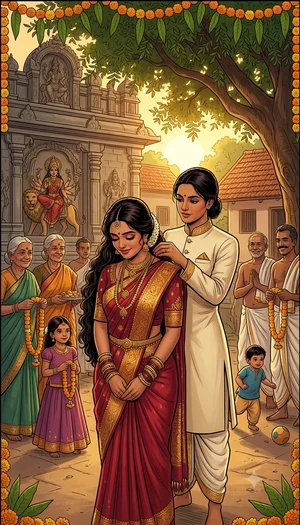
On the morning of our wedding, the temple courtyard overflowed with people. Farmers whose land I had once stolen, widows whose pensions I had delayed, and aunties I had sat with during evening prayers all came. They brought marigolds, sweets, and quiet blessings. My small acts of atonement had spoken louder than old rumors.
The older temple women helped me dress. A sudden wave of disbelief hit me — the feared Inspector Vijay, now standing here as a nervous bride in a red wedding saree. If only my old constables could see this.* Shame burned hot in my cheeks, but underneath it was something softer — acceptance.
Parvati waited for me in a crisp white and gold sherwani, tall and steady as always. When she saw me, her eyes softened with a look I was still learning to fully believe was real. She stepped close and gently tucked a stray jasmine back into my hair.
“You look beautiful, my wife,” she whispered.
The ceremony unfolded under the neem trees as golden evening light filtered through the leaves. We circled the sacred fire seven times, bangles chiming softly with every step. When she tied the mangalsutra around my neck and filled my parting with sindoor, a deep wave of warmth washed over me—not just surrender, but true belonging. The villagers cheered. No one turned away. For the first time in years, I felt truly seen and accepted.
Life settled into its rhythm after that.
The small joys and constant adjustments of daily life as Uma slowly wove themselves into my soul. Mornings began with the struggle of draping a fresh saree while my growing daughter tugged at the pallu. My long hair needed daily oiling and braiding — a ritual that once felt tedious but now brought calm. The sway of my hips felt natural now, and I caught myself smiling when the bangles chimed approvingly as I hung clothes to dry.
There were still hard days — the chafing where the petticoat tied too tight, the back pain from breasts, the way men’s eyes lingered on me in the market. But there was also unexpected pleasure: the soft comfort of a well-worn cotton saree against my skin after a bath, the pride of serving hot food to Parvati, and the quiet satisfaction of lighting the lamp at the tulsi plant every evening as a proper housewife.
Our first child, a daughter, arrived on a quiet monsoon night. I held her tiny, wrinkled body against my chest as she cried, tears streaming down my own face. We named her Durga. Motherhood tested me in ways I had never imagined— endless nights rocking her in the courtyard while singing the old lullabies my mother once sang to me. Parvati was there through every moment, patient and strong.
“You’re learning, Uma,” she would say softly. “Just like you learned everything else.”
Our days filled with simple, beautiful things: drawing water at dawn, cooking rice, dal, and brinjal fry in a simple cotton saree while Durga tugged at my pallu, sweeping the house, tending the tulsi plant, and washing clothes at the backyard stone.
Cooking had become one of my favorite rituals. I moved carefully around the small kitchen, the saree pleats secure at my waist, my fuller post-pregnancy breasts gently swaying as I stirred. The familiar weight of the mangalsutra rested between them. Sometimes milk would leak if I worked too long, leaving faint damp spots on my blouse — a constant intimate reminder of my new role as mother and wife. Yet serving hot food to Parvati and watching our children eat what I prepared filled me with a deep, peaceful satisfaction I had never known as Vijay.
Even simple tasks like washing clothes at the backyard stone became rituals of surrender. Squatting in my saree, the fabric pulling tight across my hips and breasts while I scrubbed, I often caught myself humming old temple songs. The water soaked the hem, clinging to my thighs — a constant, gentle reminder of my new place in the world.
Neighbours began visiting regularly. The widow whose pension I had once delayed brought sweets and sat with me while Durga napped. Young mothers asked for advice on fevers and school forms. I listened more than I spoke, offering whatever small wisdom I had earned through pain.
I found unexpected joy in these moments—the gentle sway of my saree as I stirred the dal, the warm weight of my breasts, the quiet pride of keeping a home. Every modest adjustment of my pallu, every evening prayer at the tulsi plant, reminded me how far I had come. The old arrogance had vanished. I feel something dangerously close to peace. Then I remember who I used to be and the guilt returns — but softer now. Like an old wound that only aches when it rains.
As Durga grew—toddling after me in the courtyard and calling me “Amma” in her sweet voice—a new longing stirred. I wanted another child. A son this time. One quiet evening while folding clothes, I confided in Parvati, my cheeks warm with shyness.
“I want to give you a son,” I said softly, smoothing a tiny shirt between my fingers. “To complete our family.”
Parvati smiled and pulled me close. “Then we will try. But you must embrace it fully, my love. No holding back.”
We chose donor sperm. The second pregnancy was harder. Morning sickness kept me near the bathroom for weeks.
My breasts grew even heavier and more sensitive as the pregnancy progressed. By the sixth month they ached constantly, straining against every blouse. Simple tasks like sweeping or bending over to pick up Durga made them throb painfully. One morning while cooking, I felt a sudden warm wetness. Two dark patches bloomed on my light blue blouse.
Milk had started leaking. I stood frozen in the kitchen, mortified, as the warm liquid trickled down. Parvati found me trying to clean myself, tears of embarrassment in my eyes.“It’s normal, my love,” she whispered, gently cupping them through the damp fabric. The tenderness in her touch mixed with the humiliation in a way that left me weak. Later that night she helped me express the milk, her fingers patient and loving. Every drop reminded me how completely this body had claimed me — no longer just a wife, but a mother.
My belly swelled round and heavy, turning simple tasks like draping a saree or bending to sweep into gentle challenges. I moved slower, one hand often supporting my lower back. The birth pushed me to my limits—long hours of pain, Parvati’s hand tight in mine, my voice breaking as I pushed. When our son finally arrived, loud and healthy, I wept with exhaustion and pure joy.
We named him Vijay Kumar. Not after the monster I once was, but after the strength I hoped he would carry—the better version of that name.
Years later, I took on the role of temple administrator. Mornings began with the aarti, my voice blending with the other women as I rang the brass bell. I handled donations, organized pujas, and listened to those who came seeking Maa Durga’s grace. Evenings brought me home to my family—cooking, playing with Durga and little Vijay, greeting neighbours with warm smiles and folded hands.
One peaceful evening, as the sun dipped behind the hills, I stood in our courtyard folding clothes. Durga helped clumsily while Vijay toddled after a ball. Parvati watched from the doorway, love shining clearly in her eyes.
I adjusted my simple cotton saree, tucked a loose strand of hair behind my ear, and felt the mangalsutra rest warmly against my skin. The Goddess had been right. As Vijay, I had power but was utterly miserable—empty, angry, and alone. As Uma, I had found something I never knew I needed: joy in surrender, in service, and in love.
I still talk to Vijay sometimes in my head. I tell him what a worthless piece of shit he was. And then I thank him for finally dying so I could become this — Parvati’s wife, the children’s mother, a woman who finally knows how to love.
The End.
Discussion (0)