
Chapter 5: Roots of Guilt
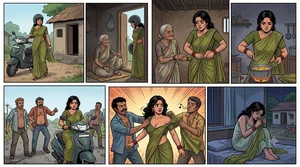
The Activa jolted over the broken road to Peddapur, my pallu whipping in the wind like it wanted to fly away from this mess of a life. In my research about the temple, I found a disappearance of Peddapur's local landlord Yadagiri. He mysteriously vanished 30 years ago , when he tried to take control of temple lands illegally.
Most of the people of the village,didnt know anything but, I was able to speak to venkatamma. A woman in her 80s, living in a poor hut in the outskirts of the village.
She was very resistant to speak to me but when I told her about the temple curse and how I was affected. she had a smirk.
“No escape, child,” she said, patting my knee. “Only remaking. It has been 30 years that I last lived as Yadagiri. I fought the transformation tooth and nail at first.”
I had asked her, voice barely above a whisper, “Is there really no way back? Any tantric, any puja, any task… anything?”
Venkatamma laughed — a dry, bitter sound that turned into a cough. “The Goddess doesn’t give refunds, beti. She only remakes. You’ll learn to live quietly, just like I did. Or you’ll break.”
Venkatamma looked at me with tired, knowing eyes. “You are still a capable girl, able to live life as a confident young woman. When I was remade , all my property was taken over by my sons and daughters. No one believed my story and I live this ostracized life outside the village".
"Be happy with your situation, Come back next week, beti. I’ll teach you how to drape a saree without looking like a fool. And how to carry the shame without letting it drown you.”
During my next visit, Venkatamma made me practice draping the moss-green saree over and over in her small hut. My breasts kept getting in the way, the pleats refused to stay neat, and the pallu slipped repeatedly. She laughed dryly, “You fight it like I did at first, beti. Stop thinking like a man.” By the end of the afternoon my hands were sore but I could drape it without looking completely foolish. The small victory felt strangely satisfying.
On another visit, Venkatamma sat me down in her tiny kitchen. “A woman’s real test is not just wearing the saree, but working in it,” she said. She made me cook simple dal and rice while wearing the moss-green cotton saree. The pallu kept slipping toward the flame, my heavy breasts bumped the edge of the low stove, and sweat made the blouse stick to my back. “Tuck it properly at the waist, beti. And learn to move gently — no more rushing like a man.”
The bangles chimed constantly as I stirred. When the dal finally tasted decent, Venkatamma gave a rare approving nod. “Good. The Goddess remakes us through these small things.” For the first time, the daily chores of this body felt less like punishment and more like a quiet path forward.
I visited her three more times that month. Each time she shared another piece of her own cursed life — how she learned to cook, how she survived her first period in public, how she eventually found peace in small daily divine rituals. “The Goddess doesn’t just break you,” she said once. “She remakes you into something softer. Whether you like it or not.”
By the time I reached my small rented house, dusk had fallen and the village was already buzzing.
Two aunties near the well were gossiping loudly as I parked the scooter.
“Did you hear? Inspector Vijay has completely disappeared!” one said.
“Arre, he must have finally angered Raghu Reddy too much,” the other replied with a chuckle. “Or maybe he ran off with some woman in Hyderabad. That man had too many enemies.”
I almost smiled bitterly..
Inside, I changed into a thin cotton nightie and sat on the edge of the bed, knees drawn up. Sleep brought no peace.
The next morning I draped the moss-green saree with still-clumsy fingers.
Instead of riding, I walked to the temple. An elderly auntie noticed me kneeling in the corner, forehead pressed to the stone.
“Beta, what troubles you so much?” she asked gently, placing a hand on my shoulder.
I wiped my face, voice thick. “I… I have done things I can never take back, aunty. Terrible things.”
Another woman sat beside me. “We all carry burdens, child. Tell us if it helps. The Goddess listens better when we speak.”
I shook my head. “Some burdens are too heavy to share. I just… I pray Maa Durga gives me strength to carry them.”
They didn’t push. One simply said, “Then stay for the aarti with us. One elderly auntie, her white saree faded from years of washing, leaned closer. “I know that look, beti. I carried the same shame for fifteen years. My husband used to beat me and take all my earnings. One day I wished him dead in my heart… and he died the next week in an accident. I thought the Goddess was punishing me for my dark thoughts. I still light a lamp for him every day, even though he was cruel. Some guilt never leaves us completely. It just teaches us how to be softer. Sometimes just sitting here lightens the heart.”
I swallowed hard. “How do you live with it, aunty?”
She smiled sadly. “By doing small kindnesses every day. The guilt becomes quieter. Not gone… but quieter.”
I stayed. The ringing bells and rising camphor smoke felt like the only shelter I had left.
In the days that followed I tried to make whatever small amends I could.
I visited the displaced farming family first. The wife shrank back when I approached their leaking tin-roof shed.
“Who are you?” she asked. “And what do you want from us?”
“I’m Uma,” I said softly. “I’m collecting stories about unfair land deals for a report. I heard what Inspector Vijay did to your family.”
The husband stepped forward, eyes hard. “That monster destroyed us. Took everything. Why do you care, beti?”
I swallowed hard. “Because someone has to. I brought rice and dal. And this…” I held out the envelope. “From the temple funds. No strings attached.”
The wife took it hesitantly. “Why are you helping us? You don’t even know us.”
I looked away. “Let’s just say I know what it feels like when a powerful man takes everything from you.”
The husband gave a short, bitter laugh. “You talk like you’ve met Vijay yourself.”
I forced a small smile. “In a way… I have. The bastard left quite the impression, didn’t he?”
Nice one, Uma. Almost joked about your own crimes. Real subtle.
They accepted the help, but the suspicion in their eyes followed me long after I left.
The widow was even harder.
I sat with her on the charpoy for a long time. She looked at me with tired eyes.
“That inspector… Vijay,” she said bitterly. “He made me wait months for my pension. When I begged, he made me sell my husband’s last silver utensils. Counted the notes right in front of me, smiling the whole time like it was a game.”
My throat tightened. “I’m so sorry you went through that, aunty. No one should have to suffer like that.”
She studied me for a long moment. “You speak like you understand the pain. Did some man hurt you too?”
“More than one,” I whispered. “And I’m trying to make it right… in whatever small way I can.”
Later that night when I tried slipping money under her door, she caught me.
“Child,” she said quietly, holding the envelope, “keep your charity. Some wounds cannot be bought away with money.”
That one stung worse than any slap.
But the hardest conversation came at the public tap.
I saw her — the young woman whose wedding I had destroyed. She was washing clothes, shoulders slumped.
My stomach twisted. I nearly turned and ran.
Instead I forced myself forward. “Behen… you look tired. Let me help you.”
She glanced up, too weary to refuse. We knelt side by side in the dirt.
After a while she spoke, voice low and full of old pain. “There was this corrupt inspector… Vijay. He spread terrible lies about me. Ruined my wedding. My family still hasn’t recovered. I don’t know how one man could be so cruel.”
I kept washing, my hands turning red. “I’m so sorry that happened to you.”
She looked at me strangely. “Why are you sorry? You didn’t do anything.”
The words nearly choked me. For one dangerous second the old Vijay arrogance flared inside me — the urge to snap back at her. I crushed it down.
“Because some men are monsters,” I said instead, voice cracking. “And sometimes the world lets them get away with it for far too long. I… I just know what it feels like to carry that kind of pain.”
Before leaving I pressed a thick envelope into her hands. “For a new beginning. Please take it. It’s not pity.”
She stared at the money, then at me. “I don’t want charity from strangers. Especially not from someone who looks like they’re carrying their own ghosts.”
“It’s not charity,” I whispered. “It’s… penance. Please.”
She looked down at the envelope, then back at me, eyes narrowing slightly.
“You keep saying sorry like you carry the weight of the whole world. What did that inspector do to you that you’re trying so hard to fix?”
I froze, throat tight. “He… took everything from someone I care about. I’m just trying to make sure no one else loses what I helped him steal.”
She gave a small, tired nod. “Then may the Goddess forgive both of you.”
She has no idea she just asked Durga Maa to forgive me twice.
That night I stood in my tiny kitchen chopping vegetables for dal, the nightie’s hem brushing my calves.
The guilt sat heavy in my chest like a stone. *This is what you stole from them,* I thought bitterly. *Their softness. Their safety.* I still didn’t deserve the kindness they showed me.
I still got angry. I still woke up some nights furious at the Goddess and at the man I used to be. But alongside the anger, something small and green was beginning to grow — like the tulsi plant in my courtyard stubbornly reaching for the sunlight after every storm.
Redemption wasn’t going to be clean. It wasn’t going to be complete. It was going to be this: day after day of small, messy, imperfect attempts. Failing. Getting back up anyway.
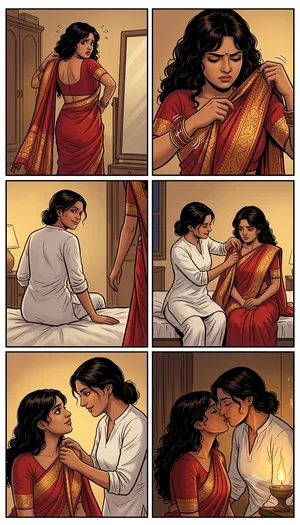
Back in the present, Parvati’s arm lay warm across my waist, her breathing steady in the dark.
“You started finding your way there,” she said quietly, fingers tracing idle patterns on my skin.
I turned toward her, resting my forehead against hers. “Slowly. Painfully. And I still mess it up sometimes.”
The story continued.
Discussion (0)