The Secret
Final Part — The Confluence of Two Rivers
On the day the war banners of Trigarta fell to the ground, the sky over Panchanada appeared cloudless for the first time in many years.
The army of Trigarta had been defeated along the borders of Trigangeya. The forces that had advanced towards the northern gates of Panchanada surrendered before the Alchemy-Perfected Warriors. Prince Durjaya of Trigarta was taken prisoner. Chaturaka’s circles of illusion had been shattered. The serpent of fear that had hung over the kingdoms lowered its head.
But something greater than victory in war had occurred.
The wall that had stood for years within Vikramasena’s heart had fallen.
When Saumyasena entered the royal palace of Panchanada, he did not come as an enemy king.
Nor did he return entirely as the old friend he had once been.
Many years of silence lived in his eyes.
In Vikramasena’s eyes was the remorse of old contempt melting away.
For some time, the two men simply looked at one another.
Neither spoke first.
At last, Vikramasena stepped forward.
“Saumya,” he said.
That single word was enough.
The years in the gurukula, the recklessness of youth, Mandakrodha’s curse, the pride that followed, and the distance that grew between the kingdoms—all of it dissolved within that one address.
Saumyasena took his hand.
“Vikrama,” he said, “when stones fall between rivers, their course may change. But rivers do not forget the sea.”
Vikramasena’s eyes filled with tears.
“I became the stone.”
“Our children removed it,” Saumyasena said.
There, the friendship between the two kingdoms was restored.
Not through the seal of a treaty, but through the joining of the hands of two old friends.
---
The marriage of Sulochanudu and Kumudvati was celebrated magnificently before both kingdoms.
To the world, it was the marriage of Prince Sulochanudu of Trigangeya and Princess Kumudvati of Panchanada.
To Panchanada, it was the union of its protectors.
To Trigangeya, it was a victory of honour.
To Sharabhanga, it was the transformation of a curse.
To Vikramasena, it was liberation from arrogance.
To Saumyasena, it was the acceptance of his son’s true nature.
To Dharinidevi, it was the crowning of her daughter’s courage.
To Bhagyavati, it was a mother’s hand resting over the wounds of her son.
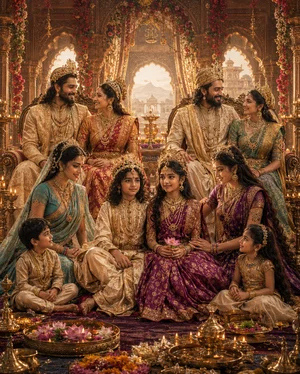
Within the wedding pavilion, Saumyasena and his wife Bhagyavati became Kumudvati’s parents-in-law. Vikramasena and Dharinidevi became Sulochanudu’s parents-in-law.
But behind all those relationships stood more than the union of families.
There also stood a vow to preserve the secret with honour.
Blessing them both, Sage Sharabhanga said:
“When form changes, fear is born.
“When the heart stands beyond form, dharma is born.
“You have not merely accepted one another’s appearances.
“You have accepted one another’s souls.
“That is why your bond is greater than an alliance between kingdoms.”
Sulochanudu looked at Kumudvati.
There was no shyness in her eyes.
No fear.
Only serene acceptance.
“Our secret?” he asked softly.
Kumudvati smiled.
“Not merely a secret. An ornament entrusted to our care.”
---
The yearly cycle began.
For one year, Sulochanudu would remain in masculine form and conduct the affairs of the kingdom, while Kumudvati stood beside him as queen.
The following year, as though time itself had turned, their forms would change.
Kumudvati would assume masculine form and take up the duties of kingship. Sulochana, once again in feminine form, would stand with grace and dignity as an adviser from the inner palace to the royal court.
When Sulochana was in feminine form, her husband was Kumudvantu.
She offered herself completely to him.
Kumudvantu knew every curve and contour of her beauty. He knew how to bring her joy. In his embrace, every rise and hollow of her body found harmony.
They became a single form so close that even air could not pass between them.
In the bedchamber, Sulochana was not merely like Rambha.
She was the very couch upon which Rambha herself might recline.
Kumudvantu savoured every hidden treasury of delight within her, down to its deepest source.
Likewise, when Kumudvati remained in feminine form, her husband was Sulochanudu.
Before him, she opened like a thousand-petalled lotus in full bloom.
Sulochanudu was the bee that drank deeply and without restraint from all the nectar hidden within that lotus.
Her beauty flowed like a stream of divine ambrosia.
---
Then another secret beyond all secrets came to pass.
No one had imagined it.
Vikramasena called Saumyasena aside in private.
“My friend,” he said, “for my sake, will you once again appear in the form of that beautiful woman from long ago, using your Art of Shapeshifting?”
“Of course, my friend,” Saumyasena replied.
Using the Art of Shapeshifting, Saumyasena transformed into a woman.
The moment Vikramasena saw her, he could no longer conceal the love that rose within him.
“Saumya!” he cried and embraced her tightly.
She too nestled into his arms.
“My lord… Vikrama,” she said.
As the two remained in that deep embrace, two voices softly cleared their throats.
From one side came Dharinidevi.
From the other came Bhagyavati.
Vikramasena immediately composed himself.
But Saumya did not know what to do.
Then the two queens laid down a condition:
From that day onward, whenever Saumyasena entered the inner palace of Panchanada, he must come only in the form of Saumya.
Everyone agreed.
Thus, only a few people knew the secret of the alternating married life of Sulochana and Kumudvati, and the secret shared by Vikramasena and Saumya.
Vikramasena.
Dharinidevi.
Saumyasena.
Bhagyavati.
Sage Sharabhanga.
The trusted minister.
And a small number of attendants sworn to absolute secrecy.
The world saw them only as righteous royal couples.
No matter who bore which form in a given year, no weakness entered the administration of the kingdoms.
Strangely, the experience of living in both forms gave them a deeper understanding of the suffering of their people.
The pain of a man.
The pain of a woman.
The burden of royal authority.
The privacy of the inner palace.
The weight of war.
The restraint of motherhood.
They experienced all of these not as separate truths, but as realities shared within a single life.
Once, Kumudvati said to Sulochana:
“If what came to us was a curse, it became a path through which we learned to understand the suffering of others.”
Sulochana smiled.
“Mandakrodha cursed us in anger. But dharma carved a path even through that curse.”
Their lives continued along that path.
In time, each bore children through the other.
The first-born were twins.
Some years later came another pair.
Those children were not merely heirs to the kingdoms.
They were heirs to a lineage that honoured the secret.
They carried Sharabhanga’s blessing, the experience of two grandfathers, the compassion of two grandmothers, and the extraordinary truth of their parents’ lives.
Sulochanudu and Kumudvati did not carry their secret as a burden.
They embraced it through mutual love.
They lived long lives filled with happiness and fulfilment.
The world saw their splendour.
Only a few understood their endurance.
---
Chaturika’s story ended differently.
After she was imprisoned in the subterranean cavern, Sage Sharabhanga performed another experiment upon her.
It was not done as punishment.
He understood that if the memory of betrayal survived, deception might one day rise again.
Through the force of his mantra, Chaturika’s former memories dissolved completely.
Chaturaka’s arrogance.
His hunger for sorcery.
Durjaya’s schemes.
Nothing remained.
When the proper time came, she entered Panchanada as an ordinary attendant.
She knew nothing of her past.
Yet, strangely, she became highly skilled at weaving garlands.
Whenever anyone asked her about it, she would smile and say:
“Flowers do not bind. They adorn.”
Once, Sharabhanga saw her from a distance and sighed in silence.
Betrayal does not always end in death.
Sometimes, forgetting is the punishment it deserves.
---
Panchanada and Trigangeya came together.
The fences along their borders remained, but the walls within their hearts disappeared.
Merchants travelled freely.
Gurukulas accepted students from both kingdoms.
Their armies trained together.
New agreements were formed to share the waters of the rivers.
Inspired by Kumudvati, the women of the royal houses began receiving training in weapons.
By Sulochanudu’s command, schools of dance began teaching bodily discipline, breath control, and the cultivation of courage.
The threat of Trigarta vanished completely.
Durjaya was imprisoned far from royal power.
The kingdom of Trigarta bowed to a treaty of peace.
Its serpent banners no longer inspired fear.
Time moved slowly forward.
The secret continued to live in silence.
---
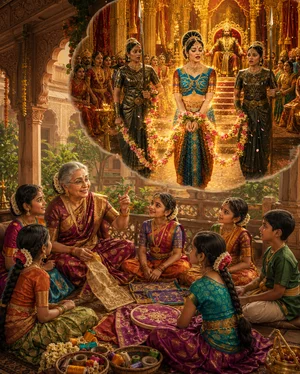
Grandmother was about to finish the story when she showed us the cloth resting upon her knees.
We all gathered around it.
It was no longer an ordinary piece of embroidery.
First, there was a garland of flowers—the witness of the royal court where chains had turned into blossoms.
Beside it was the image of two rivers joining—Panchanada and Trigangeya.
On one side was a bow.
On the other, a sword.
At the centre was the moonstone platform.
Around it turned a golden circle, symbolising the yearly transformation.
At the end stood two figures side by side—one Sulochana, the other Sulochanudu.
But the line of the eyes embroidered between them was one and the same.
We stared in wonder.
“Grandmother,” my younger sister asked, “is this story true?”
Grandmother smiled.
“You must not ask whether a story is true, children.
“Some stories endure not because they actually happened.
“They endure because they are capable of carrying truths that the human heart could not otherwise bear.”
My eldest sister asked softly,
“Then why was the secret hidden?”
Grandmother set the needle aside.
“A secret is not a hidden lie, children.
“It is a truth that is not revealed before its proper time.”
She looked at us in silence for a while.
“Secrets of the inner palace never remain still forever.
“They travel from one person’s ear to another person’s heart, from kingdom to kingdom, and from generation to generation.
“In that way, this secret reached my grandmother.
“My grandmother told it to me.
“And now I have told it to you.”
“What should we do with it?” I asked.
Grandmother placed her hand upon my head.
“Secrets like these must not be repeated as gossip.
“They must be told with respect.
“Not to those who laugh at appearances, but to those who wish to understand the endurance hidden behind them.
“When you grow older, tell more people.
“But remember this:
“In Sulochana’s story, the transformation of form is not the true miracle.
“Acceptance is the miracle.”
She tied the final knot.
The embroidery was complete.
For a long time, we continued looking at it.
Between the flower garlands, within the confluence of the two rivers, and between the two forms of Sulochana and Sulochanudu, we saw only one thing.
Not the secret.
But the love that had carried the secret with honour.
The End
Discussion (0)