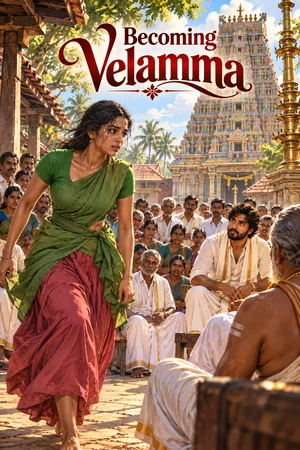
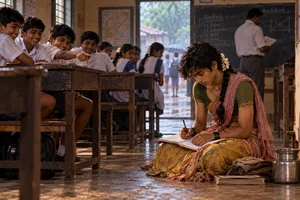
The half-saree they gave Velamma was not new. It had belonged to the daughter of the previous village maid, who died a decade ago of snakebite. It smelled faintly of old smoke and dried rice flour. Green blouse. Yellow cotton pavadai. Faded pink thavani—frayed at the ends. A symbol in the village: Not a girl. Not yet a woman. And never again a man. The Panchayat had spoken clearly: “She may not wear a full saree. She is not woman enough to deserve that dignity. Let her remain in between—always.” Velamma folded it neatly each night. Ironed it with a hot pot lid. Not for pride. Not for beauty. But because it was all she had left. One month after her punishment began, she was ordered to resume schooling. Not as Velu. That name was struck from the attendance. Her new name was Velamma, registered unofficially. There was no certificate. No identity. Just a roll-call whisper from the assistant teacher, who never looked her in the eye. “Velamma… sit at the back. Floor only.” While boys sat on benches, fought over pens, and chewed sugarcane sticks, Velamma sat cross-legged on a cold cement floor, sari edge tucked tight between her legs. The girls did not speak to her. The boys smirked when she passed. One spat near her pot of water. No one asked her what she studied. Or how. No one corrected her papers. No one asked questions. But she answered every one. In perfect Tamil. Neat handwriting. Exact punctuation. She read the same page of the textbook ten times, not because she didn’t understand, but because it filled the silence inside her chest. It was her only conversation, now. “When I read,” she whispered once to herself, tracing a page with her finger, “no one sees my face. They only hear my mind.” One evening, as rain poured over the school tiles, the students rushed out. Velamma stayed seated, watching the drops fall. The math teacher—a man who once praised Velu as “next district topper”—paused at the door. For a moment, their eyes met. Just a breath. Then he turned away, and said to another boy: “Clean the board before you go. Don’t leave that job to… you know.” She sat by her fire again, mixing hot water with leftover rice. Her fingers trembled slightly—not from shame, but from the chill. She whispered: “I have no classroom. No name. But I still have this mind. Let me hold it, if nothing else.” She reached under her mat and pulled out a small brown diary—pages cut from old schoolbooks. On each page, a copied poem. A memory. A line from a story. Not written as a protest. Just survival
Congratulations!
You've successfully completed reading all published parts of this story!
Follow the author to be notified when more parts are posted.
1008 Views0 Comments
Disclaimer
CD Stories is a multilingual open platform. Stories published are generated by writers. The platform has not reviewed, modified, or validated contents and holds no liability regarding content quality or copyright infringements.
Discussion (0)
No comments shared yet. Be the first to share your thoughts!

Discussion (0)