
She approached Kumudvati and gently touched her shoulder.
“Are you hurt?”
At that touch, Kumudvati’s fear first began to subside.
Then her heart suddenly trembled.
She believed it to be the lingering shock of escaping the tiger. But on that day, within that trembling, another feeling without a name had begun.
“Who are you?” Kumudvati asked.
Sulochana smiled.
“The living need water first. Questions can come later.”
By then, the companions had come running. The palace guards were informed, and before long, a commotion arose within the inner palace.
But Kumudvati did not release Sulochana’s hand.
“You must come with me,” she said.
“Into the inner palace?” Sulochana asked calmly.
“The doors of our inner palace will not remain closed to the one who saved my life.”
For a moment, Sulochana looked at her.
In that gaze, a thought, a calculation, and some hidden sorrow appeared and vanished.
“As you command.”
---
The moment Queen Dharinidevi saw Kumudvati, she pulled her daughter into her arms. Though the princess was unharmed, the queen’s heart was still beating with fear.
“Who saved you?” she asked.
Kumudvati pointed towards Sulochana.
The queen studied her closely.
Sulochana bowed with humility.
“Your Majesty, I was travelling along the edge of the forest. I saw the tiger attack and released my arrows. That is all.”
“Is that all?” The queen’s voice remained gentle, but the caution of a royal mother was hidden within it. “Five arrows towards the tiger’s jaws in a single breath, and one to its flank—‘that is all’ is not an ordinary way to describe such a feat.”
Sulochana did not reply.
Just then, an elderly attendant entered. She had served the queen faithfully for many years.
In her hand was a small silver tube marked with a saffron line.
It bore the seal of Sage Sharabhanga’s hermitage.
The moment the queen saw the seal, she took the attendant aside and opened the silver tube. Inside was a palm-leaf letter.
The script was Sage Sharabhanga’s.
«“Dharinidevi,
The young woman who saved your daughter today did not arrive by chance. Keep her close to Kumudvati. Give her a place as the princess’s dance teacher. Do not question her now about the path by which she came. The time has not yet arrived to reveal the complete truth, even to the king. This silence is necessary for the protection of Panchanada. When the proper moment comes, I shall personally bring the truth to light.
—Sharabhanga”»
The queen read the palm-leaf letter twice.
There was no fear upon her face. Yet she understood that the situation was far from ordinary.
For Sage Sharabhanga to send a secret message not to the king, but directly to her, was no small matter.
She turned towards Sulochana.
“Have you come from the revered sage’s hermitage?”
Sulochana bowed her head.
“I may say that I have come from there, Your Majesty. But the sage has commanded that you must not yet ask for whom I have come.”
The queen looked at her intently.
“Is my daughter in danger?”
“Yes.”
“The kingdom as well?”
“The danger to the kingdom cannot be separated from the danger to your daughter.”
At that reply, resolve appeared in Dharinidevi’s eyes.
“From this moment onward, you will remain within the inner palace. You will teach dance to the princess. I will not yet reveal the full truth about you to the king. But this is not a dishonour concealed in silence. It is a secret preserved for the welfare of the kingdom.”
Sulochana bowed.
“Your Majesty, your silence may one day save Panchanada.”
Those words remained in the queen’s heart.
---
Having said this much in the royal court, Kumudvati paused.
Vikramasena sat motionless upon his throne. At the mention of Dharinidevi’s name, thought joined the hardness upon his face.
For a moment, pain rose within him at the knowledge that the queen had concealed the matter from him.
But the name of Sage Sharabhanga restrained it.
“What happened next?” the minister asked.
Kumudvati drew a breath.
---
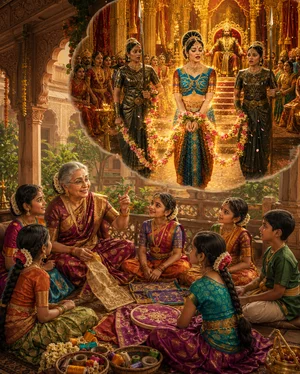
Sulochana took her place within the inner palace as a teacher of dance.
A dance pavilion was prepared for her.
The pavilion within the inner palace of Panchanada was divine in its beauty. A floor of white marble lay at its centre. Lotus-shaped pillars stood around it. Paintings of celestial dancers adorned the ceiling. When the first ray of dawn entered and fell upon the floor, it seemed as though someone had drawn a golden rhythm there.
On the first day, Kumudvati entered wearing ankle bells.
She loved dance.
But her teachers had only ever made it tedious.
Some corrected her steps.
Some demonstrated postures.
None had listened to her heart.
Sulochana stood before her.
“I have been commanded to teach dance to the princess,” she said.
Kumudvati smiled.
“Many have taught me. What will you teach that is new?”
Sulochana watched her for a moment.
“Who told you that you do not know how to dance?”
Kumudvati was surprised.
“What do you mean?”
“Your body already knows dance. Your breath does not. Let us begin by teaching the breath.”
That day, there were no steps.
There were no hand gestures.
For an entire hour, Sulochana taught Kumudvati only how to stand.
“The foot must not merely touch the earth. It must speak to it.”
“The knee must not merely bend. It must receive the rhythm.”
“The waist must not merely move. It must permit the flow of cadence.”
“The breath must not simply leave the body. It must carry emotion into the world.”
At first, Kumudvati laughed.
Then she grew impatient.
Finally, she was astonished.
For she discovered that standing still without moving could be as difficult as battle.
A few days later, Sulochana began teaching hand gestures. But behind every gesture, she revealed a secret of bodily discipline.
She taught expression. Yet behind every emotion, she taught command over the mind.
She taught footwork. Yet behind every step, she showed how the body should evade danger.
“Dance is not entertainment, Princess,” Sulochana would say. “It is complete mastery over one’s own body.”
“Then is a warrior also a dancer?” Kumudvati would ask.
“The finest warrior must certainly be a dancer. If he loses rhythm, he loses his life.”
“And a dancer?”
“If she loses rhythm, emotion dies.”
At first, Kumudvati took those words as metaphors.
But in Sulochana’s teaching, metaphor and discipline were threads that could not be separated.
---
Within a few weeks, the nature of the lessons changed.
One morning, the doors of the dance pavilion were closed. The attendants were made to stand at a distance.
Sulochana brought out a short sword.
Kumudvati looked at it in surprise.
“Is this also dance practice?”
“Yes.”
“With a sword?”
“When a sword is in the hand, the body cannot lie.”
Sulochana handed her the sword.
Kumudvati took it. Her wrist was stiff.
Sulochana came closer.
“Not like that.”
With her own hands, she corrected Kumudvati’s wrist. One by one, she loosened the princess’s fingers. She altered the pressure of the thumb and corrected the angle of the elbow.
At the moment of that touch, Kumudvati’s heart leapt.
She concealed it within herself.
“If you grip it too tightly, the sword does not become your servant,” Sulochana said. “It becomes the servant of your fear. Do not seize the sword. Show it the path.”
Kumudvati tried again.
This time, the sword no longer felt heavy.
Days passed.
Sulochana taught her the sword forms called Niyantra, Nivara, Parshva Prasara, and Praharadi.
In every movement, the step, waist, shoulder, wrist, and gaze had to become one.
“To strike does not merely mean to hit an enemy,” Sulochana said. “Before the blow comes, you must read the enemy’s intention.”
“How can one know it?”
“The eyes speak first. Then the shoulder. Then the foot. The sword comes last.”
Kumudvati looked at Sulochana in wonder.
“Where did you learn all this?”
Sulochana lowered the sword towards the floor and remained silent for a moment.
“In the forest, every sound is a teacher. In the hermitage, every discipline is a weapon.”
“Is Sage Sharabhanga your teacher?”
“The path he showed me is long.”
“Where does it lead?”
Sulochana smiled faintly.
“To the place where destiny waits.”
Kumudvati did not understand the reply.
But she did not hurry to understand it either.
Some answers, she felt, must be heard in silence.
---
The sky was overcast on the day archery lessons began.
A secret practice ground had been prepared at the edge of the garden. Grass had been cleared between the trees, and targets had been set up.
Kumudvati held the bow.
But when she placed the arrow against the string, she found it difficult to draw.
Sulochana came to stand behind her.
“Keep your feet parallel. The body must not become a slave to the target. Look forward. Draw the breath inward.”
She stood close behind Kumudvati. With both hands, she guided the princess’s arms—one hand upon the bow, the other upon the hand drawing the arrow.
For a moment, Kumudvati’s entire body became still.
Sulochana’s breath touched the side of her ear.
There was the coolness of the forest in that breath.
A trace of sandalwood.
The discipline of a warrior.
It did not merely feel as though someone stood close behind her.
It felt as though some power had surrounded her.
“Now release,” Sulochana said softly.
The arrow flew.
It struck the centre of the target.
Kumudvati did not look at the arrow.
She searched for where her heart had gone.
“Did you see?” Sulochana asked. “The arrow does not travel through the hand. It travels through the breath.”
Kumudvati nodded.
But it seemed to her that the arrow had carried not only her own breath, but someone else’s as well.
From that day onward, Sulochana’s presence was no longer merely the presence of a teacher.
It was protection.
Adoration.
Fear.
Affection.
A feeling that could not be named.
It seemed as though something had entered her heart and chosen to remain there.
---
Having said this much, Kumudvati stood silent for a while in the royal court.
Some among the courtiers lowered their heads.
Others looked at Sulochana in astonishment.
Until then, they had regarded her only as a dance teacher. Now, behind her, the disciplines of warfare, breath control, forest vigilance, and mantra seemed to stand together in a new form.
The thoughtfulness upon Vikramasena’s face deepened.
“What need is there to speak of all this before the court, Kumudvati?” Prachanda suddenly demanded. “This is merely the tale of a disciple who loves her teacher.”
Kumudvati turned towards him.
“I have not yet spoken of the most important matter, Commander.”
A flash of irritation appeared in Prachanda’s eyes.
“Then speak.”
“Sulochana taught me to recognise the gaze of an enemy. She taught me that the body must not stiffen before danger. She taught me to distinguish between a gaze that protects honour and a gaze that seeks to possess it. That is how I recognised your gaze.”
The entire court grew tense. (To Be Continued)
Discussion (0)