

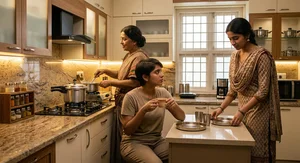
Simran arrived on a Tuesday without warning, which is to say she warned Kay on Sunday and Kay said not yet and Simran came anyway on Tuesday, which is the kind of thing you do when you love someone and have been patient for longer than patience is supposed to last.
I opened the door because Kay was at a meeting.
Simran was exactly as I had imagined from Kay's descriptions and completely different from what I'd imagined from Kay's descriptions — taller, darker, with the specific composed energy of someone who has made a decision and is finished reconsidering it. She looked at me in the teal churidar with the nose stud and the extensions and the earrings climbing both ears and I watched her reassemble her understanding of the situation in real time.
"You're Karthik," she said.
"Kavya," I said. "Today. Most days now."
She looked at me for another moment. Then: "Is Kay here?"
"She's at the bank. An hour, maybe."
She nodded. "Can I wait?"
"Come in," I said. "I'll make tea."
I made tea and she sat at the kitchen table and we looked at each other with the frankness of two people who have only ever existed to each other as descriptions and are now doing the work of becoming real.
"She didn't tell me everything," Simran said. Not accusing. Just noting.
"No," I said. "It's a lot to explain from a distance."
"She tried." She wrapped both hands around the cup. "I understood maybe half of it."
"Which half?"
"The half where she felt responsible." She looked at the kitchen, the shop visible through the interior window, the teak shelves and the gold under the tube lights. "The half where she came back and then couldn't leave because leaving felt like abandoning you. That half I understood."
I said nothing.
"The part I didn't understand," she said, "is why she's still doing it. The bank thing. It was supposed to be three meetings. It's been a month and she comes home from those meetings and she doesn't call me until late and when she calls she sounds like—" She stopped. "She sounds like someone who is becoming someone else," she said. "And I don't think it's what she wants."
"It isn't," I said.
"Then why—"
"Because she feels like she owes me," I said. "Because she thinks running the male side of this family for a month is how she pays a debt she's been carrying since the night she said something in front of me that she can't take back." I turned the cup in my hands. "And because she loves the business, underneath the guilt. She always did. She just never wanted to admit it because admitting it felt like agreeing with Amma."
Simran looked at me for a long time.
"You've thought about this," she said.
"I've had a month of evenings in this kitchen," I said. "I've thought about everything."
She smiled then, the first time — brief and real. "Kay said you were—" She stopped.
"What?"
"She said you were always the one who actually paid attention," she said. "She said you watched people. She said she was always too busy doing things to notice them and you were always standing slightly to the side noticing."
I didn't know Kay had said that. I sat with it for a moment.
"She needs to go home," I said. "With you. She came back because of guilt and she should leave because of choice. Those are different things and she deserves the second one."
"And you?" Simran asked. "What do you deserve?"
The kitchen was quiet. Outside, Madurai was doing its afternoon business — the street sounds, a vendor, an auto, the ordinary percussion of a city that did not know or particularly care what was happening in this kitchen.
"I'm staying," I said. "Not because Amma needs me to. Because this is who I am." I touched the nose stud, the reflex. "I think I knew it from the clothes. I just needed someone to leave before I could choose to stay."
Kay came home to find Simran at her kitchen table and her brother in a churidar making a second pot of tea and the look on her face when she stood in the doorway was the most complete thing I have seen on another person's face in my life — relief and guilt and love and the specific terror of being known by two people at once who between them hold every true thing about you.
"You came," she said to Simran.
"Sunday you said not yet," Simran said. "Tuesday felt like yet."
Kay looked at me. I looked back.
"She's going home," I said. "With you. The bank can find a different solution."
"Amma—"
"Amma will manage," I said. "She always does. It's her primary characteristic."
Kay stood in the doorway for another moment. Then she came in and sat down at the table and put her face in her hands, not crying, just being still in the way you are still when something you have been holding has been taken from you by someone who was strong enough to hold it differently.
Simran put her hand over Kay's without saying anything.
I poured the tea.
That evening, after Simran and Kay had gone to bed — I gave them your room, Kavya, which felt right in a way I didn't examine too closely — I sat at the dressing table in the nightgown and the waist trainer and looked at the mirror for a long time.
Not the charged looking of the December evening. Something quieter. The looking you do when you are not discovering something but simply confirming it — checking that what you believed in the daylight holds up in the dark.
It held up.
I thought about what I had said to Simran: I think I knew it from the clothes. This was true and also not the whole truth. I had known it earlier — from the brush before Amma asked me to close my eyes, from the necklace's weight finding the hollow of my collarbone, from Thankam's she said without ceremony. I had known it and qualified it and amended it and added shame to it for seven months.
What the clothes had done was remove the last qualification. Standing in those jeans with that shirt falling wrong from those shoulders, I had run out of ways to tell myself that the version in the salwar was the performance and the version in the jeans was the reality. They were both real. One of them fit.
I looked at the mirror. At the face that had been built over seven months by a mother's practicality and a doctor's prescription and a tailor's measuring tape and a parlor's needle and my own slow, reluctant, accelerating willingness.
"This is you," I said to her. To myself. To the same person, finally.
Then I turned off the light and went to sleep, and in the morning I would call Aravind and suggest we meet for coffee, and whatever happened after that would happen to someone who had chosen to be here.
Not someone who had been placed here and not yet found the exit.
Someone who had found the exit and chosen the room.
Discussion (0)