
I chose the Kanjivaram, Kavya.
The deep red one Amma had set aside in the saree shop without explanation, the one she held against my shoulder and looked at for a long moment before placing it on the yes pile. I had worn the others by now — the cotton sungudis for college, the silk for the shop's anniversary post, the teal churidar for three different product shoots — but the red Kanjivaram had stayed in the cupboard, folded in its tissue, waiting for an occasion Amma had apparently already identified without telling me.
She told me the morning of the cultural festival.
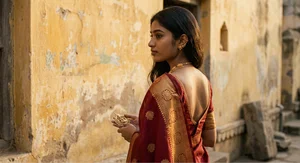
"The red one today," she said, setting it on the bed. Then she set the blouse beside it — the plunging back, Meenakshi's most ambitious work, the one I had tried on in the fitting room and stood in for a long time without speaking. Dark red silk, the front a modest sweetheart neck, the back cut away to a deep V that ended just above the waist, the edges finished with a narrow gold trim that matched the saree's border. "You'll represent the shop well in this," she said.
She left me to dress, which she had started doing — leaving me to do it myself — sometime in November, when it became clear that I didn't need the management anymore. This was its own kind of recognition, given without ceremony.
I stood in the room with the saree and the blouse and the morning light and took my time.
The blouse first.
I have learned that dressing is a sequence with its own logic, that each thing prepares the body for the next thing, and that rushing any part of it means something shows at the end that shouldn't. So: blouse first, the hooks and eyes at the back fastened with the ease that had replaced the early fumbling, the sweetheart neck settling at the collarbone, the deep V of the back open to the air in a way I had grown to like — the particular sensation of exposed skin along the spine, the slight draft of a room moving against it.
The bra underneath was a backless adhesive, skin-toned, which Amma had sourced without comment three weeks ago when the plunging back blouses had come back from Meenakshi. Practical. Invisible. The breastforms set within it, the weight familiar now as my own heartbeat, the silhouette they produced in the sweetheart neck something I no longer had to work to accept.
Then the petticoat — deep red to match, the drawstring tied at the waist where the trainer had done its work, the waist I now had without the boning, the one that was simply mine. Then the saree itself.
I have draped a saree perhaps forty times since Lakshmi-aunty first showed me, hands over mine on the fabric, talking me through the pleats. The first times were managed events, supervised, corrected. Somewhere in December it stopped being managed and became simply something I knew how to do, the way I know how to sign my name — without thinking about the individual motions, just doing them and having them arrive right.
I tucked the end into the petticoat at the waist and began the first wrap, the fabric moving in my hands with the specific weight of silk, heavier than cotton, more alive to the light. The Kanjivaram's border caught the morning sun and held it — gold thread woven into red, a pattern of temple lotuses our grandfather had chosen specifically for pieces meant to be worn on significant days. I pleated the front fall with the concentration it requires, counting folds, keeping the border even, pinning at the shoulder with a small gold pin from Amma's collection.
Then the pallu — the final drape, the length thrown over the left shoulder, falling down the back in a line that, if you had done it right, moves with you rather than against you. I let it fall and turned to check in the mirror.
It had fallen right.
Then the makeup, and here I want to be precise with you, Kavya, because precision is the point — the makeup is not the surface of the thing but the whole of it, and doing it carefully is its own form of attention, a sustained looking at a face you are also building.
I sat at the dressing table and began.
Primer first, pressed into the skin in small circles until it disappeared. Then the foundation — two shades blended at the jawline, lighter at the center, the technique Amma had taught me that gave the face dimension in photographs and also, I had learned, in person, in certain lights. I set it with loose powder in a fine brush, the excess tapped away.
Then the eyes.
The kajal first, drawn along the waterline in a single slow stroke I had practiced until my hand stopped shaking — inner corner to outer, the slight upward flick at the end that opened the eye, made it larger than it was. Then eye shadow: a warm brown in the crease, a gold at the lid, a fine shimmer at the inner corner that caught light the way the saree's border caught it. I blended with a small brush until the edges dissolved and what remained was not visible effort but simply the effect of effort, which is what you are working toward when you do this well.
Mascara in two coats, the second applied before the first had fully dried for volume. Then the brows — defined but not drawn, filled in light strokes that followed what the threading had shaped, which was by now a shape I thought of as mine.
Then the face — blush swept from the apple of the cheek toward the temple, the color I had learned was correct for this skin in this light, a warm rose that didn't announce itself but that you would notice if it were absent. A highlight on the bridge of the nose, the cupid's bow, the inner corner of the eye. The face coming forward from the powder's flatness.
Then the lips.
I had spent more time than I will admit choosing the lip color for today. In the end: a deep berry that matched the saree's tone without competing with it, applied with a brush for precision, the edges cleaned with a small concealer on a fine brush. I pressed my lips together once. Looked at the result.
Then I did something I have not told Amma and will not: I put on a second application, slightly darker at the center, the technique I had read about in one of the beauty accounts Meera had sent me that builds depth into the color. It takes thirty seconds. It changes the mouth entirely — gives it weight, intention, the quality of being meant.
I sat back from the mirror.
What I looked at for the next several minutes I will try to describe accurately, which means I have to set aside both the shame I would have reached for six months ago and the pride I am not yet sure I have earned, and simply look.
The face: arranged into something that had taken seven months to build and that looked, in the mirror, as if it had always been this way. The kajal making the eyes larger and darker than my own face used to make them. The blush giving the cheekbones a definition that was partly makeup and partly mine now, the hormones having done their own slow architecture. The lips with their dark berry weight, their intention.
The body: the red silk moving when I breathed, the gold border settling at the hip, the pallu pinned at the shoulder and falling in a clean line down the back to where the blouse's V ended and the saree's fabric resumed. The block heels lifting me to the height Kavya would have stood at in bare feet. The waist beneath the petticoat, held without the trainer now, simply itself.
The back — I turned and looked at this specifically, the long V of the blouse open from the nape of my neck to just above the waist, the spine visible, the skin the skincare routine had been tending for seven months, smooth and even and warm in the morning light, the gold trim of the blouse at the edges of the open back like a frame deciding what to make significant.
I reached back and touched the edge of the fabric at the base of the V, where the blouse ended and the saree's fall resumed. Just to know where things were. Just to feel the architecture of it.
Then I turned back to the mirror and looked at the full image and held what I saw without adding anything to it — no qualifier, no disclaimer, no amendment.
She was beautiful.
I am telling you this the way I have told you everything: plainly, at some cost, because I decided at the beginning that this account would be honest or it would be nothing. She was beautiful, and she was me, and for the length of time I stood at that mirror she was simply both of those things without one of them requiring an apology.
Then I picked up my bag and went to the festival.
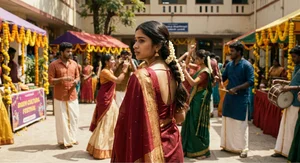
The college courtyard was already full when I arrived. Stalls arranged along the perimeter, a performance stage at the far end where someone was doing a sound check, the particular noise of several hundred young people in an outdoor space deciding where to stand. Meera found me within thirty seconds of my entering, which is her particular gift.
She stopped when she saw me.
"Kavya," she said. Just my name, or your name, the name that is both and neither. She said it the way you say something when you are revising your understanding of it.
"Is it too much?" I asked.
"No," she said. "It's correct." She looked at the blouse, the saree, the back she couldn't quite see from the front and was clearly thinking about. "Meenakshi did the back?"
"Yes."
"We're standing near the stage," she said, "where there is good light and a lot of foot traffic."
I laughed, which was real, which is one of the things Meera has given me — real laughter at the right moment, the kind that isn't performed.
We found our position near the stage. The home science department had a stall three spaces down where two of our classmates were demonstrating hand embroidery, and I drifted there and helped for a while and talked to people and was, for a period of time I didn't measure, simply present in a courtyard on a December afternoon in a red Kanjivaram saree, which is a sentence I am still learning to let be ordinary.
The engineering college delegation arrived at eleven.
I saw him before he saw me, which I am glad of, because it gave me a moment I wouldn't have had otherwise.
He was taller than I had imagined from the photographs — or the photographs hadn't communicated height, just the angle of light over Madurai at dawn and the stillness of someone who knew when not to move. He was with two other men from his college, walking along the stall perimeter, and he was looking at things with the attention I had recognized in his messages: not the scanning look of someone deciding whether something deserves consideration, but the look of someone who has already decided and is now simply trying to understand.
He stopped at the home science stall.
He picked up an embroidery sample and looked at the underside of it, which is what someone who understands craft does — you look at how a thing is made from the side that isn't performing. My classmate started explaining the technique. He asked a question I couldn't hear from where I was standing.
Then he looked up, because people look up when they become aware of being looked at, and he found me.
I don't know how long we looked at each other. Long enough that Meera, beside me, became very interested in her own hands and said nothing, which from Meera is an extraordinary act of restraint.
Then he said something to my classmate, who pointed at me with the directness of a twenty-year-old who doesn't understand that some introductions require more architecture, and he walked over.
"You're Kavya," he said. Not a question. The Instagram handle, the photographs, seven weeks of messages about craft and the city and things made to last, arriving in this particular courtyard in this particular light.
"Yes," I said. "And you're Aravind."
He looked at the saree the way he had looked at the embroidery sample — at the border, the weave, the gold thread. Then he looked at my face. "The Kanjivaram is from the shop?"
"My grandfather's design," I said. "We don't sell this one."
"Of course not," he said, and there was something in the way he said it — a simple recognition, the same thing he'd understood from the photographs — that made the courtyard go slightly quieter around us, or perhaps that was just where my attention went, narrowing to this person in front of me asking questions about fabric the way he asked questions about everything, as if the answers genuinely mattered.
Meera made a small sound beside me that I chose not to acknowledge.
We talked for perhaps twenty minutes — about the embroidery, about the shop, about the engineering college's stall on the other side of the courtyard which he said she should visit, and I said I would, and we both understood that what we were actually saying was: I want to keep talking to you and here is a reason to. He had the stillness of the photographs in person. He listened the way people listen when they are not also planning what to say next.
At some point his friends came and retrieved him for something and he said he'd be at the stall for most of the afternoon and I said I would come by later and Meera waited exactly three seconds after he left before turning to me with an expression I will not try to describe because her face in that moment contained more information than I had the capacity to receive.
"The real ones," she said.
"Stop," I said.
"I'm just saying—"
"Meera."
She stopped. Then: "The back of that blouse is extraordinary, by the way. I've been thinking about it all morning."
You arrived at two in the afternoon.
I was standing near the stage watching a classical dance performance from the host college when I felt rather than saw something change in the courtyard — a shift in the air, the specific quality of a presence that is known to you arriving in a space you didn't expect it in. I turned before I understood why.
You were standing at the courtyard entrance in dark trousers and a plain white shirt, a bag over one shoulder, shorter than I remembered or perhaps I had grown used to heels, your hair cut shorter than the last time I'd seen you, your eyes scanning the courtyard with the directness you've always moved through spaces with, looking for something.
Looking for me.
You found me.
I watched you take in the saree. The blouse. The makeup. The person standing in the December afternoon light who was wearing your name and your face's architecture in a red Kanjivaram our grandfather had designed. I watched you look at all of it — not flinching, not moving, just looking with the focused attention of someone who has been preparing for this moment since October and has still not fully prepared.
Then you crossed the courtyard and stood in front of me and said, in a voice lower than mine now, the voice that had always been lower:
"Amma's going to be so angry that I came back."
"Yes," I said.
"You look—" You stopped. Started again. "The red was always going to be yours," you said. "I never could have worn it."
I didn't say anything. The dance performance continued behind us. Somewhere across the courtyard, near a stall I had promised to visit, a man who asked questions about the underside of things was probably looking at something with his full attention.
"I'm staying," you said. "For a while. I have to."
"I know," I said.
You looked at me for another moment — at all of it, the whole seven months of it standing in front of you in a courtyard in Madurai — and then you said: "You're going to have to introduce me to the jewelry comment boy. Meera's already messaged me about him."
I stared at you.
"She found me on Instagram in November," you said, with the slightest suggestion of a smile. "She said someone needed to be keeping an eye on things."
Of course she had, Kavya. Of course she had.
Discussion (0)