
The letter arrived from the bank on a Thursday.
Amma read it at the kitchen table with the expression she reserves for numbers that refuse to cooperate, then passed it to me without comment. A property matter — the commercial lease on the shop's building, which our father had partially owned through a family arrangement that had apparently never been properly documented, now being contested by a distant cousin in Chennai who had found a lawyer willing to argue his case. The bank required the male head of household to appear in person at three separate meetings over the coming weeks, with documentation, with signatures, with the sustained physical presence of a man who could speak to the family's claim.
I put the letter down.
We both looked at it for a moment.
"Karthik needs to be available," Amma said.
"Karthik," I said carefully, "is standing in your kitchen in a salwar."
She hummed. The new humming, the one that sounds like something that has chosen its track. "Kay is here," she said.
We looked at each other. Outside, from the sitting room, came the sound of the television — Kay had arrived the previous evening, had greeted Amma with the specific wariness of a person expecting consequences and finding instead that consequences had been deferred in favor of practicality, and had spent the evening on the sofa watching cricket with the unconscious ease of someone who had always been more comfortable horizontal.
"She'll need to be convincing," I said.
"She'll need to be you," Amma said. "You'll have to show her."
I thought about this. About the specific problem of showing someone how to be you when you are no longer entirely certain what that looks like.
"I'll need my old clothes," I said.
I want to tell you about the clothes, Kavya, because they told me something I hadn't known I needed to know.
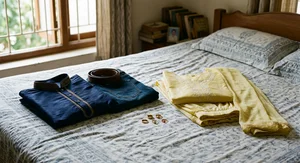
I found them at the back of the cupboard where Amma had pushed them without throwing them away, which is its own kind of statement about her — she can't quite bring herself to close doors completely, even the ones she's decided to stop walking through. The jeans, two pairs. Three shirts. A formal kurta for occasions. The old leather belt. A pair of flat shoes that had carried me through three years of Chennai office mornings.
I took them to my room and laid them on the bed and looked at them for a while. Then I started trying them on.
The jeans first. I got them up — this was possible, this was still a body that could put on jeans — but the button was a negotiation, and what the negotiation revealed was a waist and hip that had been quietly redistributing itself for seven months and had arrived somewhere the jeans hadn't anticipated. Not dramatically. Not impossibly. But differently, the fabric pulling across the hip in a way it never had, the waist sitting at an angle that was slightly wrong, the whole garment communicating that it had been designed for a different arrangement of the same general measurements.
I stood in front of the mirror in the jeans and looked at the result. The jeans looked like something being worn by someone trying to wear jeans. Which, technically, was accurate.
The shirt next. I buttoned it and stood straight — or tried to stand straight, which is where the second problem arrived. My straight was not the old straight. Seven months of heels and posture correction and the weight of the breastforms had rebuilt my default upright into something with pulled-back shoulders and a lengthened spine that the shirt, designed for a slightly rounded office-worker's slouch, did not accommodate correctly. The collar sat wrong. The shoulders were technically the right width and somehow still looked like someone else's shoulders. I pulled the shirt flat with both hands, which helped for approximately three seconds.
Then I looked at my hands.
The nails, kept short for practicality but shaped now by Thankam into something with a clean curve that was neither long nor masculine. The rings I'd been wearing — the small gold ones Amma had given me for the photographs, which I had stopped taking off. My wrists, which the hormones and the months had made slightly different — the skin, the line of them, some quality I couldn't name that made them look wrong coming out of the shirt's cuffs.
I took the rings off and put them on the dressing table. Looked again. Looked worse.
I sat on the edge of the bed for a while.
Then I reached behind me and pulled the shirt off and unclipped the bra — I had kept it on under everything, some instinct toward not solving more than one problem at a time — and sat for a moment in just the jeans, which was a combination of garments that communicated nothing coherent about anyone, and thought about what I was feeling.
What I was feeling was: wrong. Not the jeans specifically. Not the shirt. The whole arrangement — the absence of the bra's structure, the absence of the salwar's fall against my legs, the absence of the earrings' small weight and the nose stud's small point of presence on my left side. The absence of the version of myself I put on every morning the way I used to put on nothing at all, without thought, because it was simply the condition of being dressed.
I got up and opened the cupboard and took out the salwar — the pale yellow, the one I'd worn the first time I went out alone — and the bra and the forms and the petticoat. I dressed slowly, in the right sequence, each thing settling into the place it had learned to occupy. Clipped the bra. Set the forms. Pulled the salwar kameez over everything and straightened it at the hem.
Stood in front of the mirror.
The relief was immediate and specific and I am going to be honest with you about it: it felt like putting down something heavy I had been carrying for the length of time I was in those clothes. The salwar fell the way it always fell. The mirror gave me back the face I recognized. I touched the nose stud once, reflexively, which is a thing I do now the way I used to check my shirt collar — not vanity, just the small confirmation that everything is in its place.
She was back. She had, apparently, not gone anywhere. I had simply tried to leave her temporarily and found that she was not the kind of thing you can temporarily leave.
I put the rings back on and went to find Kay.
"I need to teach you how to be me," I said, standing in the doorway of the sitting room.
Kay was horizontal on the sofa with her feet over the armrest in the posture of someone who has been watching cricket for forty minutes and intends to continue. She looked at me in the yellow salwar and the gold rings and the nose stud.
"You look like yourself," she said.
"That's the problem."
She sat up. I explained about the bank letter, the meetings, the sustained requirement for a male family member. She listened with the focused expression she uses when she's decided something is her fault and is calculating the cost of it.
"How long?" she asked.
"A month, maybe. Three meetings confirmed, more possible if they contest the documentation."
She was quiet for a moment. Then: "Show me how to walk."
What followed over the next hour I will reconstruct only partially, because a complete account would require me to describe things that are genuinely difficult to put language to — specifically the experience of trying to demonstrate a self you no longer inhabit.
I tried to show her how I walked. I walked across the sitting room and turned around and said: like that.
Kay watched and then walked across the sitting room and turned around.
"That's not it," I said.
"What's wrong with it?"
"You're walking like yourself. I walked differently."
"How?"
I tried to remember how. I stood in the middle of the room and attempted to locate the old posture — the slight forward carry of the shoulders, the longer stride, the way the arms moved. What arrived instead was my current posture: pulled back, spine long, the walk that seven months of heels had installed.
"You're doing it like that," Kay said, watching me.
"I'm trying not to."
"You're doing it exactly like that."
I stood very still. "I don't remember," I said. This was the most disorienting thing I had said out loud since this started — not the name, not the clothes, this. I don't remember how I walked.
Kay looked at me for a moment with something that was not quite sympathy and not quite amusement but lived in the neighborhood of both.
"I'll just walk like a man," she said. "Not like you specifically. Nobody who matters is going to remember exactly how you walked."
"Amma will."
"Amma," Kay said, "is going to be in the kitchen pretending not to notice any of this. Which is her primary mode of existing."
This was accurate. I sat down on the sofa where she'd been lying and watched her practice walking across the room with the loose-limbed ease of someone who had always been comfortable in that register — not performing masculinity, just inhabiting the masculinity she'd always had, redirected now into the specific social role of Karthik from the jewelry family.
"The voice," I said.
She dropped her voice a register and said: "Better?"
"Say something I would say."
She thought for a moment. Then, in a voice that was approximately my voice from approximately seven months ago: "The ledger books need updating and the supplier in Trichy hasn't confirmed the March order."
I stared at her.
"What?" she said.
"That was—"
"I grew up with you," she said. "I know how you talked about the shop."
She did. She knew how I talked about the shop. What she didn't know, couldn't have known, was how I talked about everything else — the private register, the particular quality of silences, the way I held a room. But the bank didn't need that. The bank needed the son, which was a simpler and more generic performance than being me specifically.
"You'll do," I said.
"High praise," she said, and grinned, and for a moment we were just two people in a sitting room in Madurai who had swapped everything they were supposed to be and found it funny, which was not something I had expected to find in any of this but which I was grateful for more than I could say.
The month that followed I will give you in glimpses rather than full scenes, because the full scenes would fill another book and also because some of them I want to keep.
Kay at the bank in my old formal kurta, which fit her better than it had fit me in my recent attempt, her voice a register lower than her own, signing documents with a signature she'd practiced from photographs of my old receipts until it was passably mine. Coming home with the particular tiredness of someone who has performed convincingly for three hours and needs to stop.
Kay on the sofa every evening, feet over the armrest, the television at a volume Amma considered antisocial. Calling out from the sitting room asking when dinner would be ready, which she did with the specific entitlement of someone who had been waiting their whole life for a legitimate reason to be that person.
Amma in the kitchen, humming. Me beside her, chopping, stirring, learning the sequence of her sambar the way I had learned the makeup sequence — by repetition until it stopped requiring thought. Setting the table. Bringing the plates.
Setting the table and bringing the plates, Kavya.
I want you to understand what I am telling you: I set the table and brought the plates and it did not feel like a diminishment. It felt like the kitchen at seven in the evening with the pressure cooker going and the smell of curry leaves in hot oil, which is one of the oldest feelings I have, and it felt like mine.
Aravind came to the shop twice that month. The first time Kay was at a meeting and I was alone and we sat in the back among the teak shelves and talked for two hours about everything and nothing, the way we had learned to do — the conversation moving from the shop's history to the city to something he'd read to something I'd seen to a silence that had become comfortable, which is the best kind of silence, the kind that doesn't ask anything of you.
The second time Kay was home and answered the door when he knocked, and she looked at him and looked at me and said, with complete composure: "I'm Karthik. Kavya's brother. She's mentioned you."
Aravind said it was good to meet me. Me. I stood slightly behind Kay in the doorway in the dusty rose churidar and thought about the sentence she's mentioned you and what it was going to cost me later when Kay and I were alone.
It cost me approximately forty-five minutes of her sitting across the kitchen table from me with her tea, saying nothing, just looking at me with the expression of someone who has understood something fully and is waiting for me to catch up.
"I know," I said.
"I haven't said anything," she said.
"I know what you're not saying."
She drank her tea. "He looked at you the whole time he was talking to me," she said. "He was being polite to me. He was looking at you."
I looked at my own tea.
"Karthik," she said, and then stopped, and then said it again differently: "Kavya." She tried the name in the air between us like she was checking its weight. "Whatever I'm supposed to call you."
"Either," I said. "Both. I don't know yet."
"Yes you do," she said, quietly, without unkindness. "You've known since the clothes."
Discussion (0)