
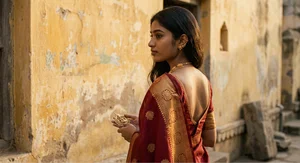
I should tell you how it started, Kavya. You know your half of it. I'm not sure you know mine.
I had been back in Madurai for eleven days when it happened. Eleven days since I'd handed in my notice at the office in Chennai — a Tuesday, my manager not even looking up from his screen, just nodding, already thinking about who'd replace me — packed the two bags that turned out to be everything I owned that mattered, and taken the overnight bus home because Amma had called four nights in a row and the last call she hadn't said anything at all, just breathed on the line until I said Amma and she said come and that was the whole of it.
The shop was worse than she'd let on. I could see it the moment I walked through the door — not the jewelry, the jewelry was still beautiful, still the same deep temple gold our father had built his name around — but the dust on the display cases that used to be polished twice a day, the single fluorescent tube doing the work of three, the half-empty trays where the mid-range sets used to sit before people stopped buying mid-range anything. Lakshmi-aunty pretending not to see me notice. Amma pretending she hadn't noticed me notice.
Eleven days of that, Kavya. Eleven days of the ledger books and the lease notice and the name of a supplier in Trichy who hadn't been paid in four months, and then you came home for what I think you intended to be three days, maybe four, your bag very light the way your bags always were, as if you'd already calculated exactly how much of home you were willing to carry back out with you.
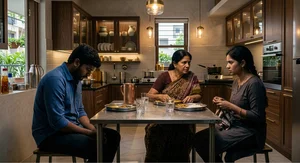
The fight started over dinner. Or it started before dinner — it had been starting for years, really, the way a fire starts long before anyone sees smoke — but dinner is when it broke open. Amma had made sambar the way you liked it, with small onions, which I noticed and you probably didn't, and she waited until we were all sitting before she said it. Not asked. Said.
"I need you to model for the shop's Instagram."
You put your spoon down. Not loudly. Just down.
"No."
"Kavya—"
"I said no, Amma. I heard the question."
"It isn't a question."
And there it was. That was always the place where the two of you stopped being able to hear each other — the place where Amma stopped asking and you heard a door slamming, and you slammed one back. I sat between you and ate my rice and thought about the tube light in the shop that needed replacing and how a new tube cost two hundred and forty rupees and whether we had two hundred and forty rupees to spend on light.
"I am not going to wear jewelry and simper into a phone camera so strangers can save the photos and feel good about traditional values," you said. "I am not that. I have never been that. You know I have never been that."
"I know you have never wanted to be useful," Amma said, and the table went very quiet.
What followed I will not reconstruct entirely. You know what you said. You know what she said. I will tell you only what I remember watching from my side of the table: Amma getting smaller and straighter at the same time, the way she does when she is most frightened and least able to show it. You getting larger, your shoulders squaring the way they always did when something was pushing you, your voice dropping rather than rising because you always fought quietest when you were most serious about it.
At some point Amma said your father's name. At some point you said his shop was never my inheritance to maintain. At some point the sambar went cold.
And then — I want to be accurate about this, Kavya, I want to be exact — you looked at me. Not to pull me in. Not to make me referee. You looked at me the way you sometimes did when we were children and you wanted to say something you didn't have Tamil words for yet, some private frequency between us that Amma's presence didn't interfere with.
Then you looked back at her.
"Use him," you said. Quietly. Almost gently, which was the most devastating way you could have said it. "He'd be better at it than me anyway. He's practically already doing it in his head."
Nobody spoke.
I looked at my plate. The rice had gone the way rice goes when the room it's sitting in drops ten degrees without anyone touching the temperature.
He's practically already doing it in his head.
You said it like you'd known for a long time and simply chosen not to hand me the information until now. Like it was the most ordinary thing, a fact about me you'd filed alongside my height and my handwriting and my habit of humming in the kitchen, things that are simply true about a person and don't require discussion. I have thought about those words almost every day since. I have thought about whether you meant them as a weapon or a door. I have never been able to decide, and I think that's because they were both, and you knew it, and you left before you had to see which way they landed.
You went to your room. You were out of the house before I woke up the next morning. Your girlfriend's car, I assumed, or a taxi, or just the will to be anywhere that wasn't here — you always had more of that than I did, that particular will.
Amma sat at the kitchen table for a long time after dinner. I washed the dishes. I dried them. I put them back in the places they'd always been. The tube light in the kitchen hummed its one flat note.
She didn't say anything to me that night, or the next day, or the day after that. She went to the shop. She came home. She ate what I made. She sat with her phone and the ledger books and the expression of someone doing arithmetic that keeps coming out wrong.
On the fourth night after you left, she looked up from the table and said my name.
Just my name. Nothing after it.
I was standing at the stove. I turned around. She was looking at me with her steady hands folded in front of her and her humming gone quiet, and what was in her face was not cruelty and not love exactly but something that lives in the same house as both of them, something that had looked at a problem for four days and arrived, with great practicality and great cost, at a solution.
I knew what she was going to say before she said it.
I think I had known since the moment you looked at me across the cold sambar.
"Sit down," she said. "I need to talk to you about the shop."
Discussion (0)