
She never said it plainly. I want you to understand that, Kavya, because I have spent a long time trying to decide whether that makes it better or worse, and I still don't know.
She sat across the kitchen table from me with her hands folded and the ledger book open between us like a prayer neither of us had the words for, and she talked about the shop. The supplier in Trichy. The lease. The catalogue shoots that used to cost eighteen thousand rupees a session and the Instagram account that cost nothing, the one that had already brought in two orders this month from women in Coimbatore and one from as far as Bengaluru who had seen a photograph and called within the hour. She talked about your father's name above the shop door and what it would mean for that name to come down. She talked about everything except the thing she was actually proposing, and I sat across from her and listened to all of it and understood every word she wasn't saying.
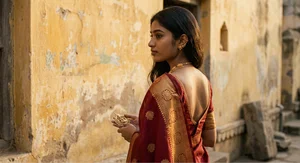
At some point she pushed the phone across the table. The Instagram account was open on the screen. The photograph from three days ago — the one I'd taken myself, setting the timer, arranging my hands the way Lakshmi-aunty had shown me, the necklace cold against my throat. Forty-three new followers since that post. Four comments. One direct message asking about pricing for a full bridal set.
She tapped the screen once. Then she folded her hands again and looked at me.
"The shop needs a face," she said. "A consistent one. Someone who knows the pieces, who can speak about them, who can—"
"Amma."
She stopped.
"I know what you're asking," I said.
The kitchen was very quiet. Outside, somewhere on our street, a pressure cooker went off — three whistles, then silence, then the ordinary sound of an afternoon continuing without us.
"Do you," she said. Not a question.
"Yes."
She looked at me for a long moment. Then she looked back down at the table, at the ledger book with its columns of numbers that kept arriving at the same wrong answer, and she said: "The Bengaluru order alone is fourteen thousand rupees."
And that was all. That was the whole of it — no naming, no asking, no moment where either of us had to hold the real shape of the thing and look at it directly. Just a number on a page and two people in a kitchen who had both decided, in their different ways, not to say the word.
I told myself, later, that I agreed because of the money. Because of our father's name above the door. Because I had nowhere else to go and nothing else to offer and the arithmetic was simple enough that even I could do it.
These things were all true. I want to be honest with you about that.
I also want to be honest about the other thing, the thing I have been circling since I started writing this and haven't let myself land on yet: I agreed faster than I should have. Not fast enough that she noticed, I think — I made her wait through a silence that was long enough to feel like reluctance — but faster than a man with real reluctance would have agreed. Something in me had already been moving toward the answer before she finished the question, like a door I'd been standing near for years that someone finally opened from the other side, and the only thing that surprised me was how little force it took.
I am ashamed of that, Kavya. I want you to know I am ashamed of it. Not of what I am, or what I was becoming, or what I would eventually let myself become — of the quickness. Of the fact that some part of me had been waiting, and I hadn't known it, or had known it and refused to look.
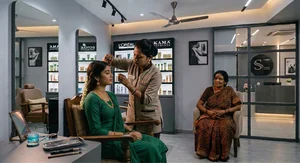
The parlor was on a lane behind the main bazaar, the kind of place that has been there so long it's become part of the street's furniture, its name on a faded board above a beaded curtain, ceiling fans running at full speed regardless of season. Amma had been going there for twenty years. The woman who ran it was called Thankam, short and precise and incapable of surprise, who looked at me when I walked in behind my mother and said nothing at all, just gestured toward the chair nearest the window as if this were an ordinary Tuesday, which for her, I realized, it probably was.
"Threading first," Amma said, settling into the plastic chair along the wall. "Then the rest."
Thankam tilted my face toward the light with two fingers under my chin, the same way you'd turn a piece of jewelry to check for flaws, and studied my brows with the professional detachment of someone assessing raw material.
"Good bone structure," she said, to Amma rather than to me, which I found I didn't mind. "The brows are heavy but workable. She's let them go."
She, Kavya. Just like that, first sentence, without ceremony or deliberation. She looked at my face and found the word and used it and moved on.
The thread was cotton, twisted and pulled in a motion so practiced it had become a single gesture, brow to temple to brow, and each pass took something away that I hadn't realized I'd been carrying. Not painlessly — there was a bright specific sting with every stroke, my eyes watering whether I wanted them to or not — but under the sting was something I was less prepared for. A kind of relief. As if the face underneath had been there all along, waiting for someone to find it.
"Stop frowning," Thankam said. "You'll undo the shape."
I stopped frowning.
By the time she was done I had brows I didn't recognize, higher and finer and more considered than anything I'd grown on my own, and when she held the mirror up I looked at the face in it for a long time before I looked away.
"Waxing now," Amma said.
What followed I will describe only partially, Kavya, because some of it I am still processing and the rest of it I find I want to keep. The wax was warm and the strips were fast and what they left behind was a smoothness so foreign to my own skin that I kept touching my forearms afterward on the auto ride home, running my fingers across them the way you touch a surface you've been told not to touch, unable to stop, half expecting the old texture to come back.
It didn't come back.
That night Amma set a salwar on my bed. Cotton, dark blue, nothing elaborate. Not yours — she'd bought it that afternoon from a shop near the parlor, while I was still sitting in Thankam's chair with wax strips on my legs. She'd bought it without measuring me against anything, just looked at the rack and known. Which meant she'd been thinking about my size before today, maybe long before today, and had simply been waiting for the conversation in the kitchen to make the thinking useful.
I picked it up. Put it down. Picked it up again.
"To sleep in," she said from the doorway. "For now, just to sleep in. You need to start getting used to the fabric."
She left. I stood in the room that had been yours and was now mine and held a dark blue salwar in my newly smooth hands and thought about what Thankam had said. She. One syllable, no ceremony.
I got used to the fabric, Kavya.
Faster than I should have, probably. Faster than a man with real reluctance would have.
I got used to it, and I slept, and in the morning Amma was already humming in the kitchen, and I lay in the dark for a few minutes before getting up, just to listen to it, because it no longer sounded like something running on a track it couldn't get off.
It sounded, just barely, like something it had chosen.
Discussion (0)