

You were always taller than me, Kavya. You know this. You have known it since you were fourteen and I was seventeen and you came home from school one afternoon and stood back to back with me in the kitchen doorway and made Amma measure us and then laughed for approximately ten minutes while I stood there pretending I didn't care.
5'6" to my 5'4". Two inches that you wore like you'd earned them, all that easy height in your shoulders, the way you took up a room without thinking about it. I spent years slightly behind you in every family photograph, angled to look taller, fooling nobody. Our relatives never said anything directly — this is a family that has always preferred to communicate shame through implication — but I knew what they were thinking. The younger sister taller than the elder brother. An ordering of things that didn't sit right with the world's expectations.
I am telling you this because I need you to understand what it meant, the morning Amma stood me against the kitchen doorframe — your old height marks still penciled there, the highest one dated three years ago — and measured me with a cloth tape and said, quietly, "Good. This will work."
Two inches shorter than you. The thing I had carried as a private embarrassment my entire adult life, the thing that made me the lesser sibling in every room we shared — and she said good, the same tone she uses when the monthly accounts come out right. That was the moment I understood that my body, which I had spent seventeen days thinking of as a problem to be solved, was actually — in her arithmetic — already most of the way to an answer.
Thankam did the extensions over two sessions, the first lasting nearly four hours.
I sat in the chair by the window while she worked in sections, parting and clipping and weaving with the methodical patience of someone who has done this ten thousand times and found a sustainable peace with it. The extensions were human hair — Amma had not skimped, which told me something about how serious she was — dark brown and fine, close enough to my own that the join, once Thankam had finished blending, was invisible even to me.
The weight arrived gradually. That's what I wasn't prepared for — not the length, which I could see in the mirror and process intellectually, but the weight, the slow accumulation of it as each section was added, until by the end I could feel my head differently, feel a presence at my shoulders and down my back that hadn't been there in the morning. When Thankam finally put down her comb and turned me toward the mirror I sat very still for a long time.
The person in the mirror had cheekbones I recognized and eyes I recognized and a jaw I had lived in for thirty-one years. Everything else was someone I was still learning the name of.
"Stop staring," Thankam said. "You'll get used to it."
She styled it then — blow-dried and shaped, a middle part, the hair falling in two dark curtains that framed my face the way hers would frame the product photography, the way a customer's eye would follow from the hair to the necklace, which was the whole point, the commercial logic underneath the transformation. I knew this. I kept knowing it and it kept not being the thing I was mostly thinking about.
The skincare instructions came that evening, delivered by Amma at the dressing table with the same tone she uses to brief Lakshmi-aunty on new stock arrivals.
"Morning: cleanser, toner, Vitamin C serum, moisturizer, sunscreen. Minimum SPF 50 for the photographs. Evening: oil cleanser first, then foam, then the night cream. This one—" she set a small brown bottle apart from the others "—for the dark areas. Elbows, knees. Every night."
She lined the products up in order of use, left to right, labelled nothing because she expected me to memorize the sequence, which I did, the way I used to memorize inventory at the shop — by repetition, by handling each thing until it became familiar.
"Your skin is already good," she said, studying my face with the critical appreciation of someone assessing a piece that needs minimal restoration. "The waxing helped. Keep out of the afternoon sun."
She left me with the products and the instructions and the mirror, and I sat there for a while doing nothing in particular, just being in the room with all of it — the extensions, the lined-up bottles, the smoothness of my own forearms on the table. Thinking about how quickly ordinary things stop being strange if you do them enough times. Thinking about you, and how you would have swept every one of those bottles off the table with one arm and called it non-negotiable.
The breastforms arrived in a box with no markings, which was either discretion or coincidence and I chose not to ask which.
Amma opened the box at the dressing table while I stood behind her watching. Inside, packed in tissue: two teardrop shapes in a skin-toned silicone, weighted and dense, more substantial than I'd expected. She lifted one out and held it for a moment, assessing, the way she holds new jewelry stock to check the finish.
"C cup," she said. "Practical for your frame. Not so large it looks wrong for your age, not so small it doesn't read on camera."
She said it the way she says everything — without ceremony, as if this were a catalogue decision rather than the reconfiguration of my body, and I have since decided that her matter-of-factness was the kindest thing she could have offered me in that moment, because it gave me no space to make it into something I had to perform a feeling about.
The bra was plain cotton, structured, a nude color that disappeared under fabric. She fitted it herself with the same steady hands that had done my makeup, adjusting the straps, checking the band, saying "breathe normally" when I held my breath without realizing it. Then she placed the forms into the cups one at a time, adjusting their position with two fingers, and stepped back.
"Look," she said.
I looked.
The weight was immediate and specific — not the diffuse weight of the extensions but something more precise, a point of gravity that changed my posture before I'd consciously decided to change it. My shoulders drew back. My spine lengthened slightly. I understood, standing there, why blouses are cut the way they are, why the necklines sweep the way they sweep — I had sold this jewelry my whole life and only now understood the architecture it was designed to rest on.
I stood in front of the mirror for a long time. Amma watched me from the doorway, saying nothing.
"The salwar," she finally said. "Try it with the salwar."
The dark blue cotton salwar from the first night — I'd been sleeping in it for two weeks — pulled on differently now. The kameez fell across the breastforms and settled into a silhouette I had only ever seen from the outside. I straightened. Turned slightly. Turned back.
"Good," Amma said. The same word as the doorframe, the same tone. Her version of something enormous.
She gave me block heels the following week. Two inches, wood sole, a simple brown leather strap across the instep. Practical, she said. For indoors, to start.
I will not describe in detail what the first three days were like. I will say only that Lakshmi-aunty witnessed at least two incidents and had the grace to find something urgent to do in the back room both times. By the end of the week I could cross the kitchen without holding anything. By the end of the second week I had stopped thinking about my feet.
What I will describe is the morning I walked the full length of the shop floor in the heels and the salwar and stopped at the display case and looked at my own reflection in the glass front, and the person looking back was 5'6" with dark hair and good cheekbones and the temple gold necklace resting in exactly the hollow it was made for.
Two inches of heel had given me your height, Kavya. Your exact height.
I stood there in the empty shop for longer than I should have, not moving, just letting that particular arithmetic settle.
The saree shop was on the main bazaar, three doors down from a sweet stall where Amma and I used to stop after school when we were children — I mean when you and I were children, when she brought us both. I don't know why I keep making that mistake. I think I am doing it on purpose.
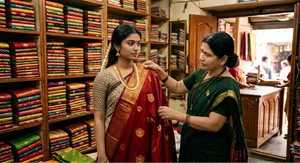
Amma chose everything. This was not discussed; she simply moved through the shop with the authority of someone who has been making textile decisions for thirty years, lifting lengths of fabric from the stacks the shopkeeper laid out, holding them against the light, setting some aside and returning others without explanation.
The salwar and churidar materials came first. Cotton for daily wear, a fine polyester blend for the Instagram photographs, two churidar sets in colors I would not have worn a month ago and now couldn't argue against because they photographed well and the business needed them to photograph well. A pale yellow that made my skin look warmer than it was. A deep teal she said would look well with the antique gold sets.
Then the sarees. Six of them, to start — her word, to start, as if this were a foundation rather than an arrival. Cotton Madurai sungudis for the house. A silk for the shop. A heavier Kanjivaram in deep red that she held against my shoulder for a long moment, looking at something I couldn't see in her expression, before setting it on the yes pile without comment.
On the auto home I sat with the parcels on my lap and watched Madurai go by outside and thought about the sarees in those bags and the fact that I did not know how to drape a single one of them and would have to learn, which meant more sessions with Amma or Lakshmi-aunty, more standing still while someone arranged fabric around me, more patience with my own body that I was discovering I had more of than I'd expected.
The tailor's name was Meenakshi, which I found briefly funny and then felt bad about finding funny. Her shop was small and meticulous, every bolt of fabric indexed, her measuring tape always around her neck like a piece of formal jewelry.
She measured me without comment and without curiosity, recording numbers in a notebook in handwriting so small I couldn't have read it from where I stood even if I'd tried. Shoulder width. Bust — over the forms, which she acknowledged and accounted for without remark, moving the tape with professional precision. Waist. Hip. Back length. Arm length.
"Blouse styles," Amma said, producing a folded page torn from a magazine — when had she found this, how long had she been preparing — on which she had marked several designs with a pen.
Meenakshi looked at the page. Looked at me. Looked at my back.
"For this structure," she said, tracing a line across my shoulder blades without touching me, "the back work will fall well. Good canvas."
The styles Amma had selected ranged from a modest boat neck to a sweetheart cut to, at the end of the page, a deep plunging back that dipped almost to the waist — the kind worn at weddings, at formal occasions, designed to be seen from behind in a draped saree. I looked at that last one for a moment.
"All of them?" I asked.
"For different occasions," Amma said, already discussing sleeve lengths with Meenakshi, the question already closed.
I stood on the small platform in the center of the room while they talked about me in the third person — her shoulders, her back, for her coloring — and tried on a sample blouse in muslin that Meenakshi pinned and repinned with quick fingers, saying "stand straight, chin up, don't hold your breath" in the same breath as if it were one instruction.
When I stepped off the platform and caught my reflection in the long mirror on the wall I saw a woman being fitted for clothes, and for the first time since this started, the seeing of it and the being of it occupied the same moment without a gap between them.
That evening Amma called me by your name in front of Lakshmi-aunty.
She didn't pause before it or after it. She said "Kavya, bring the Bengaluru order file" the same way she'd said it every other day of your life before you left, and I turned, and I brought the file, and Lakshmi-aunty looked up and then looked back down at what she was doing, and nothing was said about it.
I lay in bed that night in the cotton nightgown — your nightgown, from the drawer I'd been sleeping in for weeks, mine now by some arithmetic that required no announcement — and I said your name quietly in the dark.
Just to hear what it sounded like.
From the outside.
Discussion (0)