
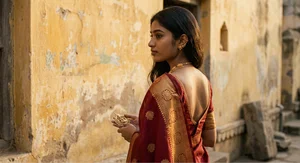
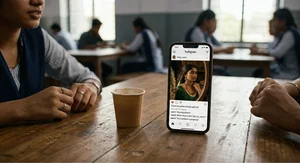
The direct messages started because of a photograph of the pendant setting — the one our father designed, the lotus base with the inlaid ruby, which Amma had let me wear for a shoot in the back of the shop where the old teak shelving was visible behind me. Aravind had commented publicly, then sent a message: I didn't want to ask this on the post but — is the setting hand-engraved or cast? The texture looks hand-done but I couldn't be certain.
I looked at the message for a day before answering. Then: Hand-engraved. My grandfather did it with a tool he made himself. My father learned from him. We still have the tool.
Does anyone still use it?
I thought about the answer. Then: I'm learning.
Which was true, actually. Amma had started showing me things — not formally, not announced, just standing beside me at the worktable in the back of the shop some evenings, demonstrating the pressure and angle of the engraving tool the way her father-in-law had demonstrated it to her husband, who had demonstrated it to nobody because nobody had seemed ready. I was ready now, or she had decided I was, or the distinction had stopped mattering.
That's rare, Aravind wrote back. Most families sell the knowledge when they sell the pieces.
This family doesn't sell what it can't replace, I wrote, and then sat with what I'd written for a moment before sending it, because it was true in more ways than I'd intended and I wasn't sure which of them I meant.
The conversations after that came every two or three days. Nothing urgent. Nothing that announced itself as more than it was — a shared interest in craft, in Madurai, in the specific character of things made slowly and by hand. He told me about his family's business, civil engineering, the frustration of building things designed to last in a city that kept changing its mind about what it wanted. I told him about the shop, the Instagram account, the Bengaluru orders that had started coming in steadily now. We talked around ourselves the way you do when you are both interested and cautious, building something from the edges inward.
I didn't tell Meera about the messages. This was not a decision I made; it was simply an absence I maintained, the way you maintain certain rooms in a house by not opening their doors.
Meera found out anyway, because Meera finds out everything within her immediate radius by some combination of attention and instinct that I have come to think of as her primary academic skill.
"You're messaging someone," she said one afternoon in the home science lab, not looking up from the embroidery sample she was attempting. "You get a specific face."
"I don't have a specific face."
"You have a very specific face. You look like you're trying not to look like anything, which is its own face." She snipped a thread. "Is it the jewelry comment boy?"
I said nothing, which she correctly interpreted as yes.
"I knew it." She set down the embroidery with the satisfaction of someone who has been right about something for several weeks. "Tell me everything."
So I told her some of it — the messages, the conversations about craft and the city, the fact that he was thoughtful in a way that didn't seem performed. I did not tell her that I read his messages twice before replying and sometimes a third time after, or that I had looked at his two photographs of Madurai at dawn until I had memorized the angle of the light in both of them.
"He sounds serious," Meera said. "The ones who ask about the craft are always serious. It's the ones who just say you're pretty that you have to watch out for."
"He said stunning once," I admitted.
"Once," she said. "About a photograph. That's fine. That's just accurate." She picked up the embroidery again. "Do you like him?"
The lab smelled of starch and the particular dust of institutional buildings. Two of our classmates were arguing quietly about tension stitches at the next bench. Outside, the college's main courtyard was doing its afternoon business.
"I don't know him," I said.
"That's not what I asked."
It wasn't. I looked at the embroidery sample in front of me, a running stitch I had been practicing for two weeks and still couldn't make even. "Yes," I said. "I think so."
Meera nodded once, the way she nods when information has been filed successfully. "Good," she said. "You should reply faster. You take too long."
The crying happened on a Wednesday.
Dr. Anitha had confirmed at the previous week's follow-up that the electrolysis was progressing well — three sessions in, the jaw line clearing, the upper lip clean, the texture of my face changing in a way that was visible now even without makeup. She said this the way she said everything, as clinical information, and I received it the same way and thanked her and left.
On Wednesday morning I stood at the mirror doing the skincare routine — the cleanser, the toner, the Vitamin C serum — and ran my fingertips along my jaw, which was smooth in the way that Thankam's threading had first made it smooth but more so now, the follicles responding to what Dr. Anitha was doing, the face underneath becoming less effortful. I pressed two fingers against my cheekbone. Turned slightly toward the light.
The tears arrived without warning or apparent cause. Not distress, not grief — or not only those things. Something that didn't have a clean name, that the hormones had apparently decided required immediate physical expression regardless of whether I had allocated time for it. I stood at the mirror with the Vitamin C serum in one hand and cried for approximately four minutes and then stopped, washed my face again, and redid the routine from the toner step.
I cried twice more that week. Once during a home science lecture on textile history when the lecturer showed a photograph of a Kanjivaram weaver at his loom, an old man with his hands in the warp threads, and something about the patience of it arrived in my chest before I could manage it. Once reading Aravind's message about a building his company had demolished to make way for a road and the way he'd written some things should be allowed to stay, which was just a sentence about urban planning and landed on me like something else entirely.
I told Meera about the first one, because she was there and saw it and handed me tissues with the matter-of-fact efficiency of someone who had grown up in a household of women and knew exactly what to do with unexpected crying. She didn't ask why. She didn't make it into anything. She just handed the tissues and said "the textile history slides get me too, that weaver photograph is a lot" and went back to her notes.
I wanted to tell her it wasn't the photograph. I didn't tell her.
Meera told me about Vikram during the walk between the main building and the canteen, which was the location she chose for most of her significant disclosures, I had noticed, probably because it offered both privacy and a natural endpoint.
Vikram was in her cousin's social circle, had been for two years, had been interested for approximately eighteen months and had only recently said so, which Meera said was the correct timeline for a person worth trusting. He was studying law in Trichy and called every evening and had once driven four hours to return a book she'd lent him, which she mentioned with the careful casualness of someone who has turned the detail over many times and found it remains significant.
"Does he know you like him?" I asked.
"He knows," she said. "We both know. We're just being careful about it."
"Why careful?"
She considered this. "Because it's real," she said. "The real ones you're careful with."
I thought about this for a long time after she said it. About what it means to be careful with something real. About a message that said there's a patience in it you don't see much anymore and the eleven minutes before it arrived and the way I had turned off the screen and lay in the dark with it.
"Tell me about him," I said. "Vikram."
She told me. All the way to the canteen and through two cups of tea and halfway back, she told me about Vikram — his voice on the phone, the way he remembered things she'd mentioned in passing weeks earlier, the book he'd driven four hours to return which turned out to have been an excuse and they both knew it was an excuse and neither of them said so. I listened and asked the right questions and felt something that was partly the intimacy of being trusted and partly something I hadn't had a word for until recently: the ordinary pleasure of being the kind of person someone tells things to.
You never told me things, Kavya. Not like this. We were close in the way siblings are close — a shared language, a shared history, the ability to communicate entire situations in a look. But not this. Not the specific texture of Vikram's voice on the phone at ten o'clock. I didn't know this kind of telling was something I was missing until Meera gave it to me.
More things were happening to my body. I will be direct about this.
The hormones were doing what hormones do, gradually and without asking permission. My face was changing in ways that were no longer entirely attributable to the electrolysis or the skincare — a softness settling into the structure of it, the angles rounding in increments small enough that no single morning showed the change but the photographs from November against the photographs from August showed it clearly. Amma had started comparing them. She didn't say anything; she just looked at them side by side with the expression she uses for before and after settings on jewelry pieces.
My body was redistributing itself. Slowly, nothing dramatic, but the waist trainer's work was being met from the inside now, and the breastforms fit differently against a chest that was beginning to have its own opinions about shape. I noticed this the way I had noticed the mannerisms — not in a single moment but in the accumulation of mornings, the fitting of a blouse that had fit one way in October and fit a slightly different way in December, a difference only Meenakshi and I would have caught but that we both caught, she with a measuring tape and I with the private knowledge of my own body.
I will tell you about one evening in December, Kavya, because it belongs in this account and I want to be honest about what the honesty costs me.
Amma had gone to bed early. Lakshmi-aunty had not been in the shop that day. I had come home from college with the kind of tiredness that isn't only physical — the tiredness of sustained performance, of being Kavya for eight hours in a room of thirty women who had no idea what they were accepting when they made room on that first day — and I had sat on the edge of the bed for a while doing nothing, which is a thing I had almost stopped allowing myself.
Then I got up and stood in front of the mirror.
I took off the salwar kameez. Unhooked the waist trainer and set it on the bed. Stood in the bra and panties in the December evening light, which comes through the window at that hour in a particular low gold that I had grown to think of as mine because it is the light I live most of my private life in.
I looked for a long time.
The changes were real. I mean: they were there in the mirror and they were also real in the sense of being mine, arrived in me, not only worn or constructed or managed. The face that the electrolysis and the hormones and six months of careful tending had produced was one I recognized not as something I had become but as something I had always been moving toward, the destination visible now that I was close enough to see it.
I reached up and unclipped the bra and held it for a moment and then set it on the bed beside the waist trainer. Stood in just the panties, in the gold light, in the quiet house.
What I felt I will only partially describe. The part I will describe is this: a fullness. Not in any single place but distributed, present, the feeling of a self that has been told it is temporary discovering that it has put down roots without being asked. I stood in the mirror and felt the weight of everything the past six months had built and for the first time didn't qualify it — didn't add and you are ashamed of this or and this is not yours or and this will end when the business no longer needs it.
I just stood there. In the gold light. And let it be what it was.
Then I got dressed and replied to Aravind's message — he had asked whether the shop would consider doing a piece on commission for a family occasion — and made dinner and went to bed.
You saw it in October, Kavya. I know this because Meera's classmate's cousin follows the account and had shared one of the posts, and the post appeared in Simran's explore page, and Simran showed it to you.
I am constructing this from inference, from the things you told me later. I wasn't there. I only know that somewhere in Pune on an October evening you looked at a phone screen and saw your own name above a face that was almost yours and felt something I don't have the right to name because it wasn't mine to feel.
I know you looked at the account for a long time. I know you went through every photograph from the beginning, which means you saw the progression — the August shoot when I was two months in, uncertain in the frame, and the October shoots when something had settled. I know that at some point you said something to Simran that you hadn't said before, about the family, about what had happened after you left, and that the conversation lasted a long time and ended with Simran holding your hand and saying nothing, which is sometimes the right thing to say.
I know, because you told me later, that you cried.
I know, because I know you, that the crying made you angry, and that the anger is what started you packing.
The cultural festival notice went up on the college board on a Monday in early December: Intercollegiate Fest — Kalai Vizha — Participating Institutions and a list of eight colleges, the third of which was the engineering college near the north campus.
Meera found me looking at it on the way to the canteen.
"I already checked," she said, not breaking stride. "His college is sending a delegation. Cultural events and a display stall."
"I wasn't—"
"You had the specific face," she said. "Come on. The sambar will be gone."
I followed her and said nothing and thought about a person I had not met, who had sent me a message eleven minutes after I had replied to his comment, who had once written some things should be allowed to stay about a building and made me cry without meaning to, who was going to be in the same college courtyard as me in three weeks.
I thought about what Meera had said about the real ones.
About being careful.
Discussion (0)