
The waist trainer appeared on my bed on a Tuesday, the way everything appears in this house — without announcement, without discussion, simply there when I returned from helping Lakshmi-aunty with the afternoon inventory. A nude colored band of firm elastic and steel boning, longer than I expected, with a row of hook and eye closures down the front. A folded note in Amma's handwriting: 8 hours minimum. Start with the loosest hooks. Work toward the middle ones by end of month.
I held it for a while. Turned it over. Read the note again as if there might be more to it.
There wasn't.
The first night I lay in the dark in the nightgown with the waist trainer hooked at its loosest setting and thought: this is what too much feels like. The boning sitting against my ribs, the compression around my middle, the nightgown's fabric pooling around something that was being slowly, deliberately remade. I breathed in shallow increments and stared at the ceiling and catalogued everything my body was currently wearing or becoming and thought about the person I had been eleven weeks ago, in Chennai, whose biggest nightly discomfort was a ceiling fan that listed slightly to one side.
Then I slept. I don't know exactly when it happened — the transition from endurance to unconsciousness — but it did, and when I woke the compression had become simply the condition of the morning, unremarkable, like weather.
By the third week I was on the middle hooks without thinking about it.
Your closet, Kavya.
I mean my closet. I keep making that mistake in the other direction now.
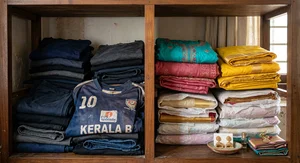
I opened it one morning looking for the teal churidar — the one Amma had chosen for a new product post — and stood for a moment taking in the full length of it. Your side, what remains of it: two dark cotton kurtas, a pair of track pants, the football jersey from your college team, faded to a color that used to be red, folded at the bottom of the shelf like something that didn't know it had been left behind. The smell of the fabric softener you always used, still faintly there if you put your face close enough.
My side: the six sarees in their folds, the salwars in pale yellow and teal and a new dusty rose Amma had added last week, the churidar sets, four blouses from Meenakshi already finished and hanging in a row — boat neck, sweetheart, cap sleeve, and the deep plunging back that I still haven't found an occasion for — the nightgowns, a second pair of block heels in black, the growing infrastructure of someone else's life.
I stood there with my hand on the teal churidar and looked at your football jersey.
Then I closed the closet and got dressed and didn't think about it for the rest of the day, which is to say I thought about it constantly.
Thankam did the ear piercings across two sessions a week apart, three holes per ear, moving up the cartilage with a practiced efficiency that made the whole thing feel like minor accounting rather than the permanent alteration of my body that it was.
The first session: one hole each, the standard lobe piercing, a small gold stud that Amma had brought from the shop's own stock — practical, she said, and good for photographs since even the smallest earring changes the whole face. The sting was brief and specific and followed by a low throb that I was told to expect and did.
The second session: two more per ear, climbing the lobe. By this point I had stopped flinching in Thankam's chair, which she noted with the closest thing to approval I had seen from her, a small sound at the back of her throat that might have been satisfaction.
Six holes total, Kavya. I have thought about what you would say about that and I think you would say something unprintable and then ask if they hurt and then look at them for a long time without saying you liked them, which in your language would have meant you liked them.
The nose piercing came two weeks later, at a different parlor Amma took me to, a place that specialized in it, a woman named Sudha who sterilized everything twice in front of us and explained the aftercare with the thoroughness of someone who had seen every possible complication and intended to prevent all of them.
"Left side," Amma said, before Sudha could ask.
I looked at her.
"Traditional," she said. "For a Tamil woman."
For a married Tamil woman, I thought, and didn't say. The nose pin worn on the left side for what it signals about a woman's status, her belonging, her availability resolved into its opposite. Amma had just told me, without saying it, what she was building toward. Not just an Instagram face. Not just a shop's representative.
Sudha marked the spot with a pen and held up a small mirror for me to check the placement and I looked at the mark on the left side of my nose and said, "Yes. That's right."
The needle was fast. The stud was small and gold. The face in Sudha's hand mirror afterward was, for a moment, not one I had to work to recognize.
The electrolysis clinic was in a quieter part of town, the kind of address that exists to be found only by people already looking for it. Dr. Anitha was brisk and matter of fact, explained the process once with the efficiency of someone who had explained it many times and trusted the information to be sufficient, and began.
I will not pretend the first session was comfortable. The probe, the flash of heat, the smell — clinical and faintly metallic — the slow methodical progress across my jaw and upper lip, clearing ground that would stay cleared. Amma sat in the waiting room. I sat in the chair and stared at the ceiling tiles and thought about permanence, about the specific character of choices that cannot be walked back, about how many of those I had now accumulated.
Afterward my face was red and faintly swollen and Dr. Anitha gave me aftercare instructions and said to return in three weeks and I nodded and paid at the front desk with money from the shop account, which meant the business was paying to make my beard stop existing, which seemed like the kind of irony I was going to have to get used to.
"It will take several sessions," Amma said on the auto home. "Six minimum. Maybe ten."
"I know," I said. "She told me."
We didn't talk the rest of the way home. Outside, Madurai continued at its ordinary volume.
The first time I went out alone I was running an errand Amma had invented, I think, specifically to make me do it — dropping off a repaired piece to a customer three streets away, a task that Lakshmi-aunty could have managed in ten minutes. I wore the pale yellow salwar, block heels, the small gold studs still new enough to catch light, the nose stud. Hair down. The makeup I had by now learned to do myself, which still surprised me — not that I'd learned it but that I'd learned it without resistance, one more vocabulary acquired because the situation required it.
The street received me without incident. This was the first thing I noticed: no incident. The world simply continued, and I moved through it, and nobody stopped to examine me or name what I was or wasn't. A vegetable vendor called me akka. An aunty from four houses down, who had known our family for twenty years, looked directly at me outside the temple and said "Kavya, you're looking so fair these days, what cream are you using?" and I told her SPF 50 and she nodded as if this were useful information and we went our separate ways.
What I had not anticipated was how much of this was not the face or the hair or the clothes at all. It was everything else. The way I had started, without deciding to, holding my elbows closer to my body when I walked. The way I turned my head at a crossing — a smaller motion than I used to make, contained, the chin leading rather than the whole head swiveling. The way my hands had stopped doing the things men's hands do in Tamil Nadu when they talk — the outward gestures, the space-claiming — and started doing something quieter instead, settling at my sides or rising to touch the nose stud when I was thinking, a habit I hadn't noticed developing until it was already there. The slight rise at the close of a sentence, the softening particle, absorbed from weeks of listening to Lakshmi-aunty and Amma and Thankam and every woman in every parlor. I had not practiced these things. They had arrived the way the waist trainer's compression had arrived — as the condition of a new morning, unremarkable, mine.
Meenakshi the tailor stopped me outside the cloth merchant's that afternoon. She looked at me for a moment the way she looks at fabric before she cuts it.
"How old are you?" she asked.
"Twenty-two," I said. Kavya's age, which I had been practicing.
She made a small sound. "You look younger. Nineteen, maybe." She said it as an observation, not a compliment or a concern, the way she says everything. "The nose stud does it. Makes the face younger."
I thanked her and walked on and did not tell her I was thirty-one years old and that the face she was reading as nineteen had spent three decades arriving at this particular arrangement of features, and that apparently all it had needed to look like a college girl was a nose stud and the right kind of attention paid to it.
My voice was the one exception. My voice I was still managing consciously, pitching it a fraction higher than natural, placing it forward in my mouth rather than letting it settle in my chest where it wanted to live. Brief exchanges were manageable. Anything sustained and the effort showed, at least to me — a seam in the fabric I could feel even when no one else seemed to see it. This was the one thing the mirror couldn't fix. I filed it away as a problem the future version of myself would have to solve.
The customer who received the repaired piece — a woman in her fifties who had been buying from our shop since before I was born — pressed my hand when I gave it to her and said "tell your mother the craftsmanship is as good as your father's" and I said I would and walked back out into the street and stood for a moment on the pavement with the afternoon sun on my face thinking: twenty years this woman has known our family. Twenty years. And she looked at me and found nothing unusual, nothing misplaced, just Kavya from the jewelry shop come to deliver a piece her mother had repaired.
Two inches shorter than you, Kavya. Your name. Your nose stud on the left side. And twenty years of a neighbor's familiarity, and not a flicker.
I don't know what that means. I am still deciding what to feel about it.
The college question came from a boy on a scooter who was lost.
He pulled up alongside me on my second solo outing and asked if I knew the way to a coaching center on the next main road, and I told him, and he said thank you and then said, as they do when a conversation has one more beat left in it: "Which college are you in?"
I looked at him. He looked at me. He was perhaps nineteen, earnest, his helmet pushed back on his head.
"I'm not in college," I said.
"Oh." He processed this. "You look like a college student. I thought—" He gestured vaguely at my general existence. "Sorry, akka."
He rode away. I stood on the pavement. Behind me, far enough back that I hadn't seen her follow, Amma was standing at the corner of the street with a parcel under one arm and an expression I recognized from the night she sat across the kitchen table with the ledger books: the expression of someone doing arithmetic and arriving, slowly, at an answer she hadn't considered before.
She didn't mention it when she caught up with me. She didn't mention it that evening, or the next day.
She mentioned it four days later, at breakfast, the same way she had mentioned the Instagram account — not as a question.
"There is a women's college forty minutes from here," she said. "Home science. The new semester begins in six weeks."
I put down my coffee.
"You want me to—"
"You need to move through the world properly," she said. "Not just the shop. Not just photographs. The Instagram account is growing. When it grows enough, people will want to know who she is. She needs to be someone."
She, Kavya. Even now, directly to me, she used the third person for whatever I was becoming. The distance of it no longer surprised me.
"I have a degree," I said. "I have a job history. I am thirty-one years old."
"Kavya is twenty-two," she said. "And enrollment requires only a transfer certificate, which I am handling."
She got up and took her coffee to the sink and rinsed the cup and that was the end of the conversation.
That night I stood in front of the mirror for a long time.
Not the quick functional glances of the past weeks — the check before a photograph, the adjustment of an earring, the assessment of a blouse's neckline. This was different. Amma was asleep. Lakshmi-aunty had gone home hours ago. The house was quiet in the specific way it gets after ten, all the daytime negotiations suspended, and I was alone with the mirror and the person in it and no particular reason to be efficient about what I was looking at.
I had dressed for bed already — nightgown, waist trainer on its middle hooks — but I stood in front of the mirror and reached up and unhooked the trainer slowly, setting it aside, and then stood in just the nightgown and looked.
The waist first. Three weeks of overnight training and the difference was visible even without the boning holding it — a softening of the straight line I'd carried my whole life, a suggestion of curve that hadn't been there before. I turned sideways. Turned back.
Then I lifted the nightgown off entirely and stood in the bra and the panties that had replaced everything in my drawer six weeks ago, and I looked.
The smoothness of my legs, so long now that I had stopped noticing it during the day and only rediscovered it in moments like this. The waist with its new suggestion. The bra sitting against my ribs, the forms inside it, the weight and shape of them that I had also stopped noticing during the day — carrying them had become simply the condition of moving through the world — but that in the mirror, in the quiet and the low light, looked like what they looked like.
I am not going to lie to you about what I felt, Kavya. I have been honest about the quickness and the waiting and the closing my eyes before Amma asked me to, and I am going to be honest about this too.
I felt something that I didn't have a clean name for. Not pride exactly. Not shame exactly, though shame was present, underneath, the way it has been underneath everything since the night in the kitchen. Something that lives between recognition and wanting — the specific feeling of seeing a thing you have wanted without knowing you wanted it and understanding, too late or just in time, what the wanting was always about.
I stood there for a long time. The nose stud caught the light. The earrings caught the light. The mirror gave me back a woman I was still becoming, not finished, not arrived, but closer than yesterday and further from where I started than I could have mapped from the beginning.
What the mirror also gave back, and what I hadn't fully seen until now in one unbroken image: the posture. Shoulders back from the breastforms' weight, spine lengthened by the heels even though I wasn't wearing them now, a natural tilt to the head I had apparently acquired somewhere in the past eleven weeks without marking the exact day it arrived. The hands at my sides held differently than they used to — quieter, closer. Even standing still and alone and unobserved, the body had decided something about how it wanted to occupy space. I had not taught it this. It had simply learned, the way bodies learn things when you ask them to do something long enough and consistently enough that the asking stops being necessary.
"This is what she looks like," I said to you, quietly, to the room, to the absent you that I carry everywhere now.
Then I put the nightgown back on, hooked the waist trainer at the middle hooks, and went to sleep.
Discussion (0)