

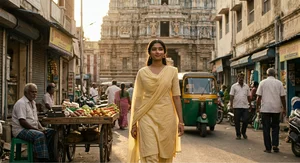
The doctor's name was Dr. Priya Sundaram and her clinic was in a part of Chennai I didn't know, which I understood was deliberate — Amma had found her through a contact she didn't name, a chain of discretion I wasn't meant to follow too closely. We took the early bus and arrived before the clinic opened and sat in the waiting room without speaking while a ceiling fan ran overhead and a receptionist organized files with the focused energy of someone who had decided not to notice anything unusual about any particular patient.
Dr. Sundaram was perhaps fifty, precise in the way of people who have learned to waste nothing — no words, no motion, no expression beyond what the situation required. She examined me without ceremony, asked questions Amma answered on my behalf when she could, and looked at me directly when she couldn't, which I appreciated more than I expected to.
"You understand what this involves," she said. Not a question.
"Yes," I said.
She looked at Amma. Then back at me.
"I'm asking her," she said. Her. Same as Thankam, same effortless arrival at the word, except this one was a doctor in a clinical setting and carried more weight for that.
"I understand," I said.
She wrote the prescription with the same efficiency she'd used for everything else — estrogen, a low starting dose, with instructions for monitoring and a follow-up in six weeks — and handed it to me, not to Amma, which was the second thing she did that I was grateful for, and which told me something about the kind of doctor she was.
On the bus back to Madurai I held the prescription in my lap and looked out the window at Tamil Nadu going by in the early afternoon light — the red soil, the banana plantations, the small towns that announced themselves in Tamil and English on blue boards and receded before you'd properly arrived in them — and tried to locate what I was feeling about the piece of paper in my hands.
What I found was this: not dread. Not the quickness-and-shame of the kitchen table. Something quieter than both. Something that felt, very distantly, like a door opening onto a room I had been walking past for years.
I didn't say this to Amma. I folded the prescription and put it in my bag and watched Tamil Nadu go by until Madurai appeared and we got off and went home.
The effects were not immediate and not dramatic. This I want to be accurate about, because the story I am telling you has enough of the improbable in it without me adding invention to the parts that were simply gradual.
What arrived first, over the following weeks: a softening at the edges of things. My skin, which the skincare routine had already improved, becoming something different underneath the routine — more responsive, more alive to touch, as if the surface had been replaced with something thinner and more honest. The waist trainer's work becoming easier to hold, the shape more willing to stay.
What arrived later: a sensitivity I won't describe in detail because some of it I am still learning to live in, and some of it belongs only to the mirror and the quiet house after ten and the dark that I have been telling you things in all this time. I will say only that there were mornings I stood at the dressing table doing the skincare routine and stopped, suddenly, for no reason I could name, and stood very still for a moment, and then continued.
Amma noticed without saying she noticed. She said instead: "You need to drink more water. Your skin will hold it better now."
This is how she loves, Kavya. You know this. She loves in information and instruction, in the practical tending of a thing she has decided matters. I have been on the receiving end of it for six months now in ways I never was before, and I find — and this is the shameful part, the quick part, the part I am telling you because I promised to be honest — I find I have grown to need it. The way she checks the blouse hem before I leave the house. The way she notices when the waist trainer has done its work. The way she said, once, looking at me across the shop before a customer arrived: "Your father would have found a way to make this right too."
She meant the business. I chose to hear something else, and I didn't correct myself.
The vocal training came through a woman named Vasantha, who taught Carnatic music to the daughters of Amma's social circle and who had, according to Amma, a gift for "placing the voice correctly." She was told I was preparing for a public-facing role with the jewelry business and needed to project better. She accepted this explanation with the serenity of someone who had long ago stopped needing the full story.
"Breathe," she said, the first session, and I breathed, and she put two fingers lightly on my collarbone and said "from here, not from here" — touching my sternum — "the chest voice is the one pulling you down. We want the mask resonance. The forehead, the cheekbones. Try again."
I tried again.
"Again."
I tried again.
She was not unkind. She was simply relentless in the way of people who understand that a thing only changes through repetition, and that patience is not a feeling but a practice. I sat with her twice a week for six weeks and learned to place my voice forward, learned to breathe from my collarbone and let the resonance live in my face rather than my chest, learned that femininity in speech is not only pitch — which is what I had been clumsily managing on my own — but breath and rhythm and the speed at which certain syllables are released.
What I didn't tell Vasantha was that the Tamil I was absorbing alongside the vocal exercises was changing too — the particles and rhythms of the women around me settling into my patterns so naturally that I sometimes caught myself, in the shop or on the street, constructing sentences the way Lakshmi-aunty would construct them. Not performance. Just what happens when you listen long enough.
By the sixth week Vasantha said, "Much better. You sound like yourself now."
I thanked her and thought: yes. That is exactly the problem and the gift of it.
The enrollment form asked for: name, date of birth, previous academic records, photograph, transfer certificate.
Amma had handled everything except the photograph, which she took herself at the dressing table on a Sunday morning, natural light, the pale yellow salwar, hair half-up. The kind of photograph that goes on an ID card and is immediately forgotten by everyone who sees it except the person in it.
I looked at it for a long time after she showed me on her phone screen.
"You look like a student," she said.
"I look nineteen," I said.
"You look like Kavya," she said, which was the closest she had come, in six months, to saying what she was actually saying.
The first day I will tell you quickly because the details of it matter less than the single thing I carried out of it.
I wore the dusty rose salwar. Block heels. The extensions pinned half-up the way Thankam had shown me for practical days. Three earrings per ear, the smallest studs climbing the cartilage, the nose stud on the left. The waist trainer under the kameez, which I had by now stopped thinking of as a constraint and simply thought of as the shape of my mornings.
The college was exactly what it had always been — a mid-tier women's institution in a building that smelled of chalk and coconut oil and the specific ambition of young women whose families had decided education was a reasonable investment. I registered at the administration office and was given an ID card and a timetable and directed to a classroom on the second floor where thirty young women between the ages of seventeen and twenty-three were settling into the new semester.
They made room. That's the thing I carried out. I walked into a room of thirty women and they made room — moved bags off chairs, offered notes from the introduction session I'd missed, told me their names and asked mine — with the automatic, unexamined ease of people receiving someone who obviously belonged. Nobody looked twice. Nobody looked once, in that particular way, the way that means the looking is actually checking.
Thirty women, Kavya. And I walked in and they made room.
I sat down and got out a pen and opened the notebook Amma had bought, which was pale blue with a small floral print on the cover, and I wrote the date at the top of the first page in handwriting I had spent three weeks softening from its old angles.
Then I wrote, underneath it, just for me, in handwriting nobody else was looking at:
She belongs here.
The Instagram account crossed five thousand followers on a Thursday in November.
Amma showed me the notification the way she shows me everything — without ceremony, the phone screen held briefly toward me, then put away. But she hummed for the rest of the morning, the old humming, and when a customer came in and complimented the new bridal sets she'd seen "on that girl's Instagram," Amma said "my daughter has a good eye for presentation" and didn't look at me once while she said it.
My daughter.
The customer left. The shop settled back into its afternoon quiet. I stood at the display case and arranged a set of earrings that didn't need arranging and thought about what it means to be claimed. Whether being claimed in the wrong name by the wrong word in front of a stranger still counts, in some currency I don't have a name for yet, as being claimed.
I think it does. I'm not proud of thinking so.
It was Meera who showed me the comment.
Meera was my bench partner in home science — small, forthright, the kind of person who treats new acquaintances as friends until given specific reason not to, which I had found to be the most useful quality imaginable in someone I was sitting next to five days a week. She had my number by the end of the first week and sent voice notes at a frequency that still slightly surprised me.
She showed me the comment on a Friday afternoon in late November, holding her phone across the bench with the expression of someone sharing mildly interesting news.
"Someone's been commenting on every one of your posts," she said. "For like three weeks. Look."
I looked.
The handle was @aravind.v.madurai. The comments were brief and consistent — an observation about a particular piece, a question about the craft, once simply the word stunning under a photograph of the Kanjivaram saree shoot, which had been the most successful post yet in terms of engagement. Nothing inappropriate. Nothing that demanded a response. Just a presence, accumulating steadily across weeks of posts, like someone returning to a door they hadn't knocked on yet.
"He goes to the engineering college near the north campus," Meera said, with the authority of someone who had already looked. "His page is mostly cricket and coffee. Very boring except apparently he has taste in jewelry." She retrieved the phone. "You should reply."
"I'll think about it," I said.
"You've been thinking about replying to comments for three weeks," she said. "That's not thinking, that's avoiding."
She was not wrong. I had read @aravind.v.madurai's comments many times, each one, in the order they'd arrived, in the late evenings when the house was quiet. I had looked at his page — Meera was right, cricket and coffee and two photographs of Madurai at dawn that were, quietly, better than they needed to be. I had thought about what it meant that someone had looked at a photograph of the temple gold against the yellow salwar and come back, and come back again, and said nothing that asked for anything except to keep looking.
That night I opened the Instagram account and found the most recent comment — the craftsmanship on the pendant is extraordinary, is this a family technique? — and typed a reply.
Yes. Three generations. My grandfather designed the original mould.
I put the phone down. Picked it up. Put it down.
The reply notification came eleven minutes later.
It shows. There's a patience in it you don't see much anymore.
I read it twice. Then I turned off the screen and lay in the dark in the nightgown and the waist trainer and thought about patience, and what it looks like from the outside, and who was looking.
Discussion (0)